How AI Is Changing Web Development in 2026
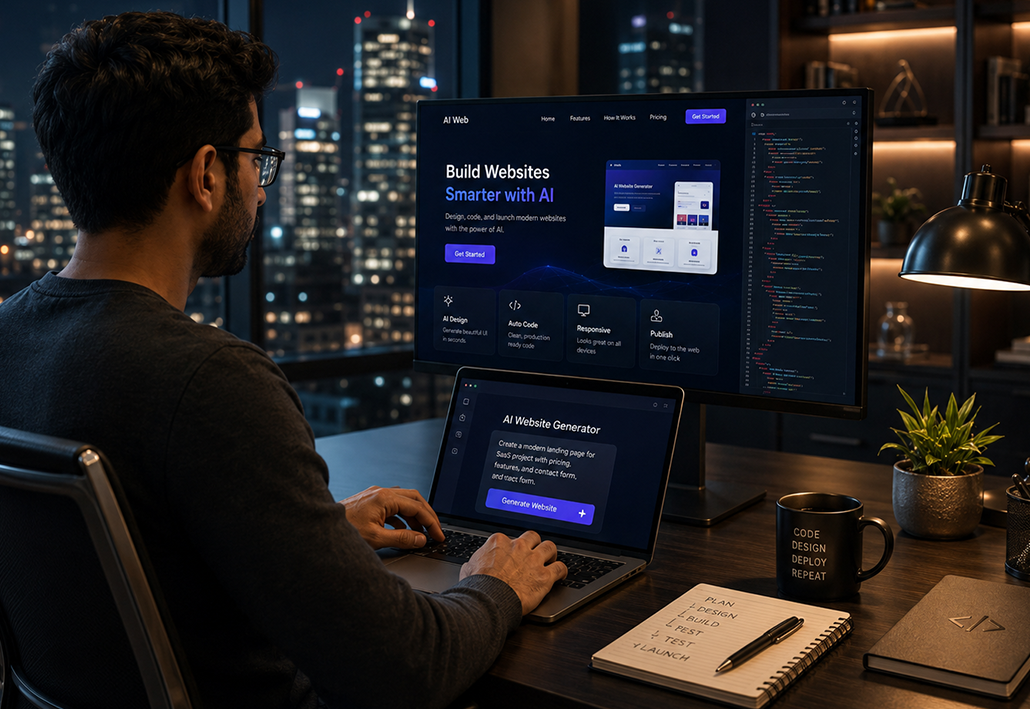
Websites used to take months to build. Today, AI can generate a functional, design-ready site in under an hour. That's not a future prediction—it is happening right now, in 2026. Whether you are a developer, a business owner, or someone looking to launch your first website, understanding how AI is changing web development—as well as AI website development workflows and emerging AI web design tools—is essential.
At WebMaffia, we work with this technology every day, and this guide breaks down exactly what has changed, which tools are leading the shift, and what it means for you.
What Does AI in Web Development Actually Mean?
AI in web development refers to the use of machine learning, generative models, and intelligent automation to assist or fully handle tasks that previously required human developers and designers.
This covers a wide range: writing and debugging code, generating UI layouts, creating responsive designs, optimising site performance, personalising user experiences, and even managing content at scale. In 2026, AI does not replace the entire development process—but it dramatically compresses it.
How AI Is Changing Web Development in 2026
1. AI Code Generation for Websites
AI code generation has become one of the most impactful applications of AI in web development. Tools like GitHub Copilot, Amazon CodeWhisperer, and Cursor act as intelligent co-pilots inside code editors—suggesting entire functions, fixing bugs in real time, and translating plain English instructions into working code.
Developers who once spent hours writing boilerplate now generate it in seconds. The result: faster delivery, fewer repetitive errors, and more time spent on architecture and problem-solving.
What this looks like in practice:
- A developer types a comment like "build a responsive navigation bar with dropdown support"—and the AI writes it.
- Debugging sessions that took hours are flagged and resolved in minutes.
- Junior developers ship production-quality code faster than ever before.
This is the kind of efficiency the team at WebMaffia integrates into every project—combining AI speed with senior-level development judgement.
2. Generative AI for Web Design
Generative AI for web design has moved far beyond basic templates. Platforms like Framer AI, Wix ADI, and Adobe Firefly allow users to describe a website and receive a fully structured, visually coherent design—complete with typography, colour palettes, and layout hierarchy.
This matters for businesses because it dramatically lowers the barrier to professional design. You no longer need a dedicated UI/UX team to build something that looks credible and converts.
Key capabilities of AI web design tools in 2026:
- Auto-generating homepage layouts from a brand brief
- Creating multiple design variations for A/B testing
- Adapting layouts automatically for mobile, tablet, and desktop
- Suggesting design improvements based on UX best practices
3. No-Code AI Web Development
No-code AI website builders have become legitimately powerful. Platforms like Webflow, Durable, and 10Web combine drag-and-drop simplicity with AI that generates copy, selects imagery, and builds entire site structures—all without a single line of code.
This has opened web development to an entirely new audience: small business owners, solopreneurs, marketers, and freelancers who need fast, professional results without the cost of a full development agency. An AI-powered website builder can feel like an agency in a box for simple sites—though custom work still benefits from expert oversight.
4. AI-Powered Personalisation and Dynamic Content
Static websites are becoming a liability. In 2026, AI enables websites to dynamically adapt content, CTAs, layouts, and even pricing based on who is visiting—their location, device, behaviour, and stage in the buying journey.
This kind of personalisation was previously exclusive to enterprise platforms with massive budgets. Now, tools like Mutiny, Optimizely, and even Shopify's built-in AI layer bring it to businesses of all sizes.
Why this matters: personalised experiences consistently outperform generic ones. Higher engagement, lower bounce rates, and improved conversion rates are the measurable result. When WebMaffia builds websites for clients, AI-driven personalisation is increasingly a default recommendation—not an optional add-on.
5. AI for Frontend Development
AI tools for frontend development now handle much of the repetitive work that slows down even experienced developers. From auto-generating CSS to producing accessible HTML structures, AI assists at every layer of the frontend stack.
Notable tools in 2026:
- v0 by Vercel—generates React components from natural language prompts
- Copilot in VS Code—context-aware code suggestions across HTML, CSS, JavaScript, and TypeScript
- Locofy.ai—converts Figma designs directly into production-ready frontend code
The time-to-production for frontend features has dropped significantly as a result.
AI-Generated Websites: Pros and Cons
Before committing to an AI-first development approach, it is worth understanding both sides—especially if you are comparing AI-generated websites to traditionally built properties.
Advantages:
- Dramatically faster build times—days instead of months
- Lower upfront costs for businesses and startups
- Accessible to non-technical users via no-code platforms
- Consistent design quality without relying on a full design team
- Built-in SEO and performance suggestions in many tools
Disadvantages:
- Output quality varies; AI still struggles with highly custom or complex interactions
- Over-reliance on AI can produce generic, similar-looking sites across competitors
- Requires human review and refinement for accuracy, tone, and brand consistency
- Data privacy considerations when using third-party AI platforms
- AI tools have a learning curve and are not always intuitive for non-tech users
The takeaway: AI works best as a powerful collaborator, not a complete replacement for strategic thinking. That is a principle WebMaffia applies on every engagement—AI accelerates the work, but human strategy drives the outcome.
Will AI Replace Web Developers?
This is the question everyone is asking—and the honest answer is: not entirely, but the role is evolving fast. Searches around AI replace web developer often miss the nuance: AI will replace tasks, not developers.
What is shifting is which tasks developers spend their time on. Repetitive, mechanical work—writing boilerplate, basic styling, simple CRUD functionality—is increasingly handled by AI.
What AI cannot reliably do:
- Understand complex business logic and translate it into architecture decisions
- Build trust with clients and manage project scope
- Create genuinely original, brand-specific design thinking
- Handle edge cases and user research
- Make strategic calls about what a product should do and why
Developers who learn to use AI tools effectively—and who focus on higher-order skills like systems thinking, client communication, and product strategy—are not at risk. They are in demand. The real risk is for developers who resist adapting.
What Businesses Should Know About AI Web Development
If you are a business owner or marketing manager evaluating your website strategy, here is what matters most right now.
Speed is no longer a differentiator—it is a baseline. With AI, any competitor can launch a professional site quickly. What differentiates you is strategic clarity, content quality, and brand depth. This is where working with an experienced team like WebMaffia makes a measurable difference.
AI-built sites still need human input. The best results come from combining AI speed with human judgement. Use AI to build fast, then refine with purpose.
Budget expectations have shifted. Entry-level AI website builders can produce a functional, SEO-ready site for a fraction of traditional development costs. But complex, conversion-optimised websites with custom integrations still require experienced developers—AI just makes them faster to build.
Maintenance is easier. AI tools increasingly handle routine updates, SEO monitoring, and performance optimisation automatically—reducing ongoing maintenance overhead.
FAQ: AI in Web Development 2026
What is AI web development?
AI web development is the use of artificial intelligence tools—including code generators, design assistants, and no-code builders—to automate, accelerate, or enhance the process of building websites and web applications.
Can AI build a website from scratch?
Yes. In 2026, tools like Durable, Wix ADI, and Framer AI can generate complete websites—including layout, copy, and imagery—from a brief description. The results are increasingly professional, though human refinement is still recommended for custom or high-converting sites.
What are the best AI tools for web development in 2026?
Some of the most widely used tools include GitHub Copilot and Cursor for coding, Framer AI and Webflow for design, v0 by Vercel for frontend component generation, and Durable or 10Web for AI-powered no-code site building.
Will AI replace web developers?
AI will automate many repetitive development tasks, but it will not fully replace developers. Demand is shifting toward developers who work effectively alongside AI tools, focus on strategy and architecture, and translate complex business needs into robust digital products.
How long does it take to build a website with AI?
A basic AI-generated site can be ready in under an hour. A fully custom, conversion-optimised website with integrations and unique branding typically takes days to weeks—but AI reduces that timeline significantly compared to traditional development.
Is AI web development good for SEO?
Many AI website builders include built-in SEO features such as meta tag generation, site speed optimisation, and structured content. However, strong SEO still requires strategic keyword research, quality content, and ongoing optimisation—areas where human expertise remains essential.
How much does AI web development cost?
Costs range from free (basic AI site builders) to hundreds of dollars per month for enterprise tools. AI-assisted custom development from an agency like WebMaffia typically costs less than fully manual development, as AI reduces the hours required without compromising on quality.
Conclusion
AI is not coming for web development—it is already here, already reshaping how sites are built, designed, and maintained. For businesses, that means faster timelines, lower costs, and more accessible tools than ever before. For developers, it means an evolving skill set and an opportunity to deliver more value by focusing on what AI cannot do.
The question is no longer whether AI belongs in web development. It is whether you are using it to your advantage.
You can also contact us for professional website design and development to combine AI speed with strategic, conversion-focused execution.
following blog articles.