SEO Isn't Dead — But
the Old Rules Will Tank
Your Rankings. What
Actually Works Now
The headlines come in waves. "SEO is dead." "AI killed search." And every time, brands that believed them paid for it.
But 2026 is different. The fundamentals of how search works have genuinely shifted in ways that make old-school tactics not just ineffective, but actively damaging. If you are still running SEO playbooks from 2020 or even 2022, you are not standing still. You are moving backward.
The brands winning in search today are doing something categorically different. This guide breaks down exactly what changed, what it means for your SEO strategy, and what to do about it.
Every Few Years, Someone Declares SEO Dead. They're Always Wrong - But Also Partly Right
The headlines come in waves. "SEO is dead." "AI killed search." And every time, brands that believed them paid for it.
But 2026 is different. The fundamentals of how search works have genuinely shifted in ways that make old-school tactics not just ineffective, but actively damaging. If you are still running SEO playbooks from 2020 or even 2022, you are not standing still. You are moving backward.
The brands winning in search today are doing something categorically different. This guide breaks down exactly what changed, what it means for your strategy, and what to do about it. And if at any point you want expert hands on the wheel, Webmaffia is the team built to help you get there.
How Search Has Fundamentally Changed in the Last 24 Months
Google's Algorithm Is No Longer Just Matching Keywords
For most of search's history, Google matched words on pages to words in queries. The page with the most matches plus the most links usually won. That model is dead.
Google now uses large language models to interpret intent, not just vocabulary. When someone searches "best way to handle a difficult client," Google is not looking for that exact phrase. It is understanding the user's context, their likely next question, and what answer would actually help them. This changes everything about how content needs to be structured and how authority needs to be demonstrated.
AI Overviews Have Reshuffled the Entire SERP Landscape
Google's AI Overviews now appear at the top of results for a huge percentage of informational queries, synthesising answers before users see a single organic link. Thin, generic content gets ignored. Well-structured, authoritative content gets cited — and being cited inside an AI Overview has become one of the most valuable forms of organic visibility available.
Zero-Click Searches Now Account for the Majority of Queries
Most searches now end without a click. Users get their answer from a snippet, a knowledge panel, or an AI Overview and move on. This is not purely bad news. Brand visibility is now partly decoupled from traffic. A user who sees your brand cited in AI answers repeatedly still builds trust and recall that influences future buying decisions. Optimising for visibility and authority, not just clicks, is now essential.
Users Now Search on ChatGPT, Perplexity, and Gemini — Not Just Google
Google is still dominant, but it no longer has a monopoly on information-seeking. Millions of people start research on ChatGPT, Perplexity, and Gemini. These platforms pull from the open web. Brands with strong topical authority and well-structured content appear in AI-generated answers. Brands with thin or generic web presence are invisible.
Old SEO Rules That Are Now Actively Hurting Your Rankings
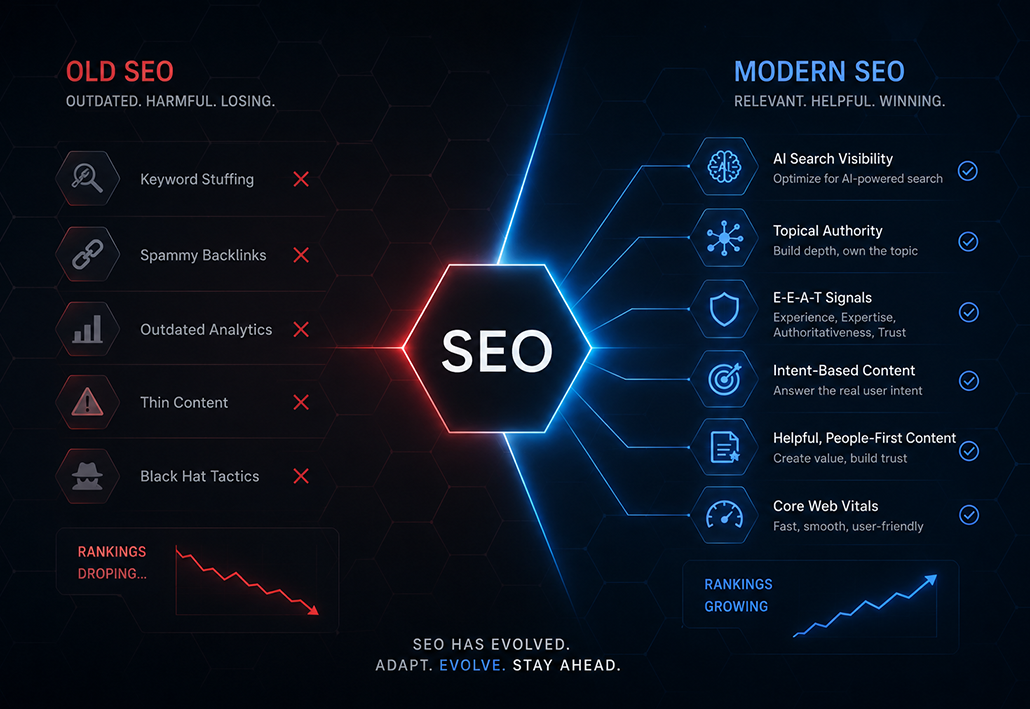
Keyword density. Hitting a keyword percentage in every paragraph signals to Google that content was written for a machine. It actively damages your E-E-A-T signals and can trigger penalties in competitive niches.
Backlink volume over quality. A thousand directory submissions or paid links from irrelevant sites do not just have zero value. They create patterns that trigger algorithmic demotion. One link from a genuinely authoritative, relevant site is worth more than hundreds from link-hosting farms.
High-volume, low-quality content. The content farm model was dismantled by Google's Helpful Content Updates. Google now evaluates content site-wide. If a significant proportion of your pages are thin or generic, that signal drags down the entire domain.
Exact-match anchor text everywhere. Over-optimised anchor text reads as a manipulation signal. Google expects natural variation, and ignoring this is a well-documented cause of ranking suppression.
Targeting keywords instead of topics. Building isolated pages around individual keywords creates a fragmented content structure that consistently underperforms a cohesive, topic-based approach.
Ignoring page experience and Core Web Vitals. Slow, visually unstable pages frustrate users and send negative signals to Google. In competitive SERPs, page experience is the differentiator between otherwise similar content.
Building pages for bots, not people. Hidden text, keyword-stuffed metadata, and content structured for crawlers rather than readers are all liabilities. What is good for users and what is good for rankings have largely converged.
Treating SEO as a one-time setup task. SEO is a continuous practice. Brands that set it and walk away are continuously falling behind brands that monitor, update, and adapt.
What Actually Works in SEO Right Now — and Why
Topical Authority Over Individual Keyword Rankings
The most important strategic shift in SEO over the last two years is from keyword rankings to topical authority. A site that comprehensively covers a subject area, with depth, interlinked content, and genuine expertise, consistently outperforms a site that targets isolated keywords — even with fewer total pages. Google rewards coverage, not just presence.
E-E-A-T: Experience, Expertise, Authoritativeness, Trustworthiness
The addition of "Experience" to Google's quality signals means content written by people with direct, lived experience on a topic now holds an advantage. Author bylines with genuine credentials, original case studies, first-person expertise, and proprietary data all contribute. This is not just a content quality signal. It is a brand trust signal.
Search Intent Matching — Not Just Keyword Matching
Every query reflects an intent. Someone searching "CRM software" might be researching, comparing, reviewing, or ready to buy. The right content for each stage is completely different. Google accurately identifies intent and rewards content that matches it precisely. Getting the intent wrong means underperforming regardless of how well the content is written.
Content Depth That Answers the Full Conversation
High-performing content in 2026 does not just answer the headline question. It anticipates follow-up questions, addresses objections, and provides the context a reader needs to act. This is what Google's systems reward when building AI Overviews: sources that deliver complete, contextually rich answers, not just one-line responses to a query.
Entity-Based SEO: Becoming Recognised in Google's Knowledge Graph
Being recognised as an entity in Google's Knowledge Graph is different from ranking for a keyword. It means Google has a model of who you are and what you stand for. Building entity recognition involves consistent branding across the web, structured data markup, author entities connected to content, and brand mentions in authoritative contexts. Brands with entity recognition enjoy significant advantages in knowledge panels, branded search, and AI citation.
Core Web Vitals and Page Experience
In competitive SERPs where content quality is similar across multiple strong sites, page experience metrics become the differentiator. LCP, INP, and CLS are Google's real-world measures of user experience. Sites that consistently score well have a measurable and growing ranking advantage. This is directly tied to how your website is built and maintained — which is why Webmaffia's design and development service treats Core Web Vitals as a non-negotiable baseline.
Structured Data and Schema Markup
Schema markup lets you communicate directly with Google about what your content contains. Well-implemented structured data increases rich snippet appearance, knowledge panel visibility, and AI Overview citation rates. Many competitors have not caught up on structured data, making it one of the highest-return technical investments available right now.
Internal Linking as a Topical Authority Builder
Internal links show Google the relationships between your content, signal which pages are most authoritative on a topic, and distribute page authority effectively across your site. Most brands treat internal linking as an afterthought. Treating it as a deliberate topical authority signal delivers compounding returns that cost nothing beyond the effort.
The Content Strategy That Worked in 2020 Is a Liability in 2026
From Keyword-First to Intent-First Content Planning
The old process: pull keyword data, sort by volume, write a page for each term. This produces content that serves a spreadsheet, not a user. Intent-first planning starts with the actual questions, concerns, and decision-making journey of your target audience. Keywords are a data input, not the starting point. At Webmaffia, our content marketing strategy is built on this exact principle: understand the audience first, then build content around what genuinely serves them.
Why Thin Content Is Getting Wiped Out by Helpful Content Updates
Google's Helpful Content Update introduced a site-wide signal evaluating whether the majority of content on a domain is genuinely useful versus produced for rankings. Sites with high proportions of generic, AI-generated, or aggregated content have seen domain-wide traffic declines that are not recovering. This is a permanent shift, not a temporary penalty.
The Pillar-Cluster Model: How to Build Topical Depth That Ranks
A pillar page provides comprehensive coverage of a broad topic. Cluster pages cover specific subtopics in depth. Internal links connect all clusters back to the pillar. This structure signals genuine expertise across a topic domain and creates natural user pathways that improve engagement — both of which support rankings.
Original Research and Proprietary Data: The Highest-Authority Content in 2026
Content with original data is the hardest to replicate and the most likely to earn natural backlinks. When your site is the only source of a particular finding, every site referencing that data must link to you. Surveys, internal data analysis, industry benchmarks, and case study data all serve as long-term link building assets with compounding returns.
Technical SEO in 2026: What Still Matters and What Does Not
Crawlability and indexation are the non-negotiable foundations. None of your content strategy delivers results if Google cannot crawl and index your pages. Robots.txt, canonical tags, XML sitemaps, and regular Search Console monitoring are baseline requirements, not optional extras.
Core Web Vitals remain a confirmed SEO ranking factor. The shift from FID to INP made interactivity scoring more demanding for JavaScript-heavy sites. Regular monitoring and a defined remediation process for regressions should be standard practice.
Site architecture and URL structure matter more as your content library grows. Logical hierarchy and clear URL patterns signal topical relationships to crawlers and make your content easier to navigate for users.
JavaScript SEO is still a live risk. Sites relying heavily on client-side rendering may be hiding content from Google or slowing indexation. Server-side rendering or static site generation should be the default for any new build prioritising search performance.
Log file analysis is the technical audit step most brands skip. It reveals exactly which pages Googlebot is crawling, how frequently, and where it encounters errors — which is direct data no third-party tool can replicate.
A strong technical foundation is also something Webmaffia's digital strategy service integrates from day one, ensuring every layer of your search performance builds on solid ground.
Link Building Is Not Dead — It Just Grew Up
Why 10 High-Authority Links Beat 1,000 Directory Submissions
The gap between high-quality and low-quality links has widened significantly. A single contextual link from an authoritative publication in your industry moves rankings in ways that bulk directory links cannot. Effective link building in 2026 focuses on earning editorial links through genuinely citable content, expert commentary, and original research.
Digital PR and Earned Media as the New Link Building
Digital PR treats link building as a communications function. Creating genuinely newsworthy assets — original data, expert perspectives, timely industry commentary — and pitching them to relevant journalists earns links from high-authority publications at a quality level paid schemes cannot match. It also builds brand visibility beyond search, creating compounding effects across channels.
Brand Mentions Without Links Still Build Authority
Unlinked brand mentions contribute to Google's understanding of your brand's authority and relevance. Multiple Google patents describe systems that evaluate brand mentions across the web independent of link equity. Building genuine brand presence through PR, partnerships, and industry participation creates these mentions naturally.
Internal Links Are the Most Underused SEO Lever
Every new piece of content should be linked to from relevant existing pages. High-priority pages should receive more internal links. A deliberate internal linking audit conducted quarterly consistently reveals significant opportunities to improve authority distribution and topical signalling at zero cost.
SEO in 2026 Also Means Optimising for AI — Not Just Google
How Google AI Overviews Decide Which Content to Surface
AI Overviews do not simply reproduce top-ranking pages. They synthesise from multiple sources, prioritising content that directly answers the query, uses clear structured formatting, and comes from domains with established topical authority. Building genuine content quality and topical authority improves both traditional rankings and AI Overview citation rates simultaneously.
Optimising for Featured Snippets Is Now Optimising for AI Answers
The content structures that win featured snippets — concise direct answers, formatted definition blocks, numbered process lists, comparison tables — are exactly what AI systems extract and cite. Featured snippet optimisation and AI answer optimisation are now the same practice. Every piece of content should include at least one clearly formatted answer block addressing the primary query directly.
Why Your Structured Data Strategy Determines AI Citation Probability
Well-implemented schema markup removes ambiguity about what your content contains and means. It increases the probability that AI systems correctly identify, categorise, and cite your content. Brands investing in comprehensive structured data are building a systematic advantage in both traditional and AI-powered search.
GEO and AEO: The Two New Layers Every SEO Strategy Needs
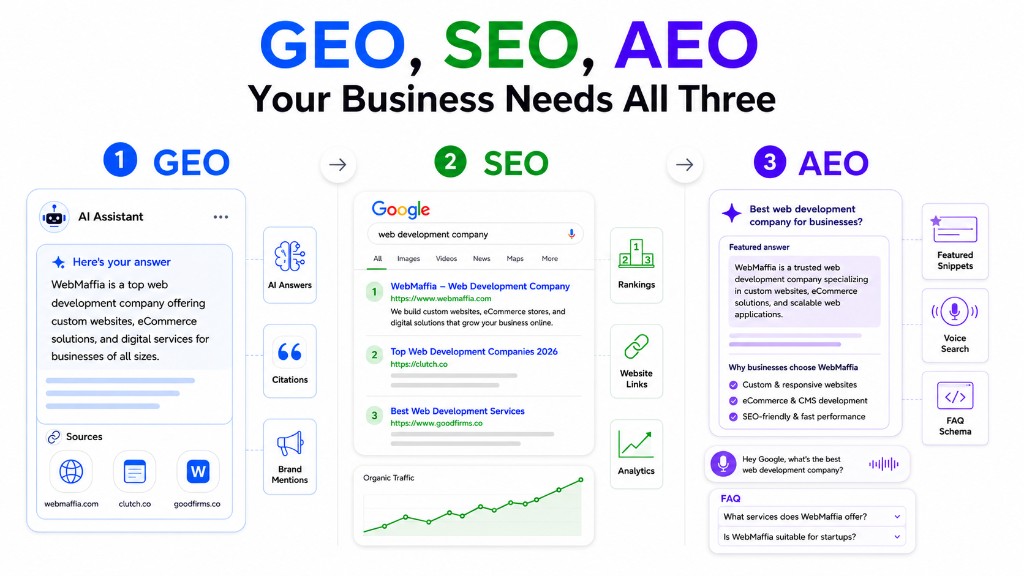
GEO (Generative Engine Optimisation) optimises for visibility within AI-generated answers across ChatGPT, Perplexity, Gemini, and Google AI Overviews. AEO (Answer Engine Optimisation) structures content to be selected as direct answers by these systems. Neither replaces traditional SEO. Both build on top of it. The brands that will dominate the next three years are building all three layers simultaneously.
How to Measure SEO Success in 2026 — Beyond Rankings and Traffic
Why Ranking Number One Means Less Than It Did Three Years Ago
With AI Overviews, featured snippets, ads, and local packs now dominating the top of results pages, position one in the blue links receives significantly less traffic than it once did. Rankings still matter. They are just no longer sufficient as the primary success metric.
Metrics That Actually Matter: Organic Conversions, Share of Voice, AI Citation Rate
The metrics that reflect real business impact include organic conversion rate (not just sessions), share of voice across target topic areas, and AI citation rate across platforms where this can be measured. These are harder to track than position rankings — which is exactly why most brands do not track them. That gap is an opportunity.
How to Track Zero-Click Visibility in Google Search Console
Search Console reports impressions alongside clicks. Pages with high impressions and low click-through rates are often appearing in snippets or AI Overviews where users get answers without clicking. Tracking impression volume as a separate metric captures visibility that click data misses entirely.
Brand Search Volume as a Proxy for SEO and GEO Authority
Rising brand search volume is one of the clearest signals that your search strategy is building genuine authority. When people search for your brand by name, it reinforces rankings across all target queries. Google Trends, Search Console, and brand monitoring platforms can track this over time.
Your 2026 SEO Reset: What to Stop, Start, and Double Down On
Stop producing content to satisfy a keyword list. Stop measuring success by ranking positions alone. Stop treating any tactic Google has explicitly deprecated as an acceptable risk. Stop equating volume with performance. One deeply researched, expert-authored piece delivers more SEO value than twenty generic articles combined.
Start building content in topical clusters with deliberate pillar-cluster architecture. Start demonstrating E-E-A-T signals explicitly through author credentials, original research, and case studies. Start implementing structured data across every content type on your site. Start treating content as a long-term authority asset, not a short-term traffic driver.
Double down on technical SEO fundamentals. Crawlability, Core Web Vitals, and clean site architecture are the foundation everything else is built on. Double down on page experience. Double down on entity authority. Building a recognised brand entity in Google's Knowledge Graph is the single most durable SEO investment you can make.
FAQ
Is SEO still worth investing in for 2026?
Yes, without question. Organic search remains one of the highest-ROI marketing channels, particularly for high-intent buyers. The strategies required have evolved, but the commercial value has not diminished. Brands with genuine topical authority and strong technical foundations are gaining share from those running outdated playbooks.
What are the most important Google ranking factors in 2026?
Topical authority, E-E-A-T signals, search intent matching, Core Web Vitals, high-quality backlinks from relevant sources, and structured data implementation. Site-wide content quality, as evaluated by the Helpful Content signal, underpins all of them.
Has the Google Helpful Content Update changed SEO permanently?
Yes. It introduced a site-wide signal that evaluates the proportion of genuinely useful content on a domain. Sites built on keyword volume rather than genuine value have seen structural traffic declines that are not reversing. This is a permanent shift, not a temporary penalty.
What is topical authority and why does it matter?
Topical authority is the degree to which your site is recognised as a comprehensive, reliable resource on a specific subject. High topical authority means new content ranks more easily, performance is more stable across algorithm updates, and your brand is more likely to be cited in AI-generated answers.
How does AI affect SEO strategy in 2026?
In two ways. First, Google uses large language models to evaluate content semantically, rewarding genuine depth and expertise. Second, AI platforms including ChatGPT, Perplexity, and Gemini are now significant surfaces for brand visibility. Optimising for AI citation (GEO and AEO) is now a necessary complement to traditional search optimisation.
What old SEO tactics should I stop using immediately?
Keyword stuffing, bulk link acquisition, thin high-volume content, exclusive exact-match anchor text, isolated keyword targeting, and treating SEO as a setup task. Any tactic that prioritises manipulating search engines over serving users is now a liability.
The Foundations That Actually Hold Up
The brands dominating search in 2026 are not the ones with the most content or the most backlinks. They are the ones with the deepest expertise on well-defined topics, the strongest technical foundations, and the most consistent investment in genuine quality over tactical shortcuts.
If your current SEO strategy feels like it belongs to a previous era, that instinct is accurate. The shift from keyword-first to intent-first, from volume to depth, from manipulation to authority, is achievable — and it compounds over time.
Webmaffia brings every layer of digital visibility under one roof. Whether you need a sharp digital strategy to chart the path forward, end-to-end SEO execution that keeps pace with Google's evolving standards, or a website built for both performance and search, the team has done it for businesses across industries. Beyond search, Webmaffia also covers social media marketing, content marketing, and influencer marketing — so your brand's visibility is never dependent on a single channel.
following blog articles.