GEO, SEO, AEO -
Your Business Needs
All Three
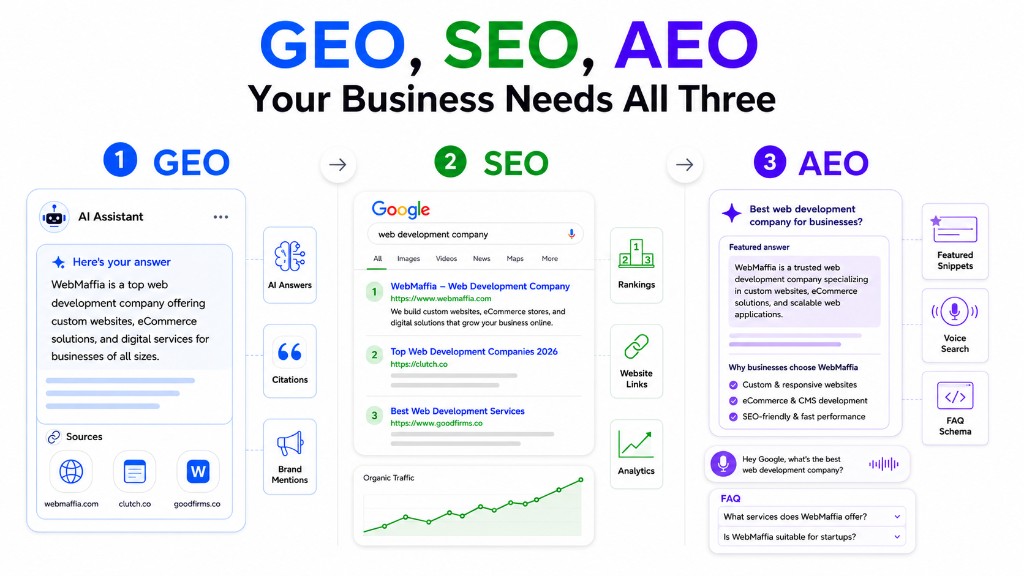
GEO, SEO, AEO - Your Business Needs All Three. Here's the Order That Actually Matters
The Way People Search Has Changed. Has Your Strategy?
At Webmaffia, we work with brands across industries on one consistent challenge: they are investing in visibility, but the landscape they are optimising for has quietly shifted beneath them. The strategies that drove results two years ago are delivering less - not because they were wrong, but because the way people search has fundamentally changed.
Think about the last time you Googled something. Did you click a link - or did you read the answer right there on the page and move on?
Now think about how many of your customers are skipping Google entirely and typing their questions directly into ChatGPT, Perplexity, or Gemini.
This is not a future scenario. It is happening right now, in 2026, at a scale that most brands are not prepared for.
The rules of digital visibility have fundamentally shifted. Ranking on page one of Google is no longer enough. Being findable is no longer enough. Today, your brand needs to be the answer - and increasingly, the source that AI cites when it constructs that answer.
That requires three distinct but interconnected strategies: SEO, AEO, and GEO. Most brands are doing one. Some are doing two. The ones pulling ahead are doing all three - in the right order, with the right priorities.
This guide breaks down exactly what each one means, where they overlap, and how to build a visibility stack that works in the AI-first search landscape of 2026 - with a clear look at GEO vs SEO vs AEO and what brand visibility in AI search actually requires.
What Are SEO, AEO, and GEO?
Before diving into strategy, let's establish clear definitions. These three terms are often used interchangeably - they shouldn't be.
What Is SEO?
Search Engine Optimization is the practice of improving your website so that it ranks higher in traditional search engine results pages (SERPs) - primarily Google and Bing.
SEO encompasses technical website health (site speed, crawlability, mobile-friendliness), on-page content optimisation (keywords, metadata, internal linking), and off-page authority building (backlinks, brand mentions). It has been the cornerstone of digital marketing for over two decades, and it remains essential - but it no longer operates in isolation.
What Is AEO?
Answer engine optimization is the practice of structuring your content so that search engines and voice assistants can extract and surface it as a direct answer - without the user needing to click through to your website.
AEO targets featured snippets, People Also Ask boxes, voice search responses, and the structured answer formats that Google increasingly uses to respond to conversational queries. The goal is not just to rank, but to be selected as the definitive response to a specific question.
What Is GEO?
Generative engine optimization is the practice of optimising your brand's content and online presence so that AI-powered tools - ChatGPT, Perplexity, Google's AI Overviews, Gemini, and others - cite your brand, reference your content, or recommend your products when generating responses.
This is what is GEO in digital marketing in its purest form: ensuring that when a large language model synthesises an answer about your industry, your brand is part of that synthesis. GEO does not primarily chase clicks. It chases citations, brand mentions, and AI-level authority.
SEO vs AEO vs GEO: Key Differences at a Glance
Platform: Where Each Strategy Operates
SEO operates primarily within traditional search engines - Google, Bing, and their respective SERPs. Your success is measured by where your pages appear in those ranked lists.
AEO operates at the intersection of search engines and voice assistants - Google Assistant, Siri, Alexa, and the featured snippets and structured answer formats within Google Search itself.
GEO operates within generative AI platforms - ChatGPT, Perplexity, Google AI Overviews, Microsoft Copilot, and any LLM-powered interface that synthesises answers rather than listing links.
Goal: What Each One Is Optimising For
SEO optimises for ranking - getting your pages to appear as high as possible in a list of results.
AEO optimises for selection - getting your content chosen as the direct answer to a specific query.
GEO optimises for citation - getting your brand referenced, recommended, or quoted by an AI model when it generates a response.
Success Metric: How You Measure Each
SEO success is measured through keyword rankings, organic traffic volume, click-through rates, and domain authority scores.
AEO success is measured through featured snippet capture rate, voice search visibility, and the percentage of queries where your content appears as a zero-click answer.
GEO success is measured through AI citation share - how often your brand appears in AI-generated responses - as well as AI Overview impressions and the qualitative weight your brand carries in generative outputs.
Why 2026 Is the Tipping Point for Brands
Zero-Click Searches Have Hit 60%+ - And Climbing
More than 60% of searches now end without a click. Users get what they need - a date, a definition, a recommendation, a comparison - directly on the results page. For informational queries, that number is even higher.
This is not a trend brands can afford to ignore. If your entire digital strategy is built on driving traffic from search results pages that more than half of users never leave, you are optimising for a shrinking pool of opportunity.
Users Now Start on ChatGPT, Perplexity, and Gemini - Not Google
AI search optimization is no longer an alternative to Google. For a growing segment of users - particularly younger, more tech-forward audiences - it is the default starting point.
When someone asks ChatGPT "what's the best project management tool for remote teams" or asks Perplexity "which accounting software do small businesses trust most," they are not going to Google first. They are going straight to an AI that will synthesise an answer and potentially name specific brands. If your brand is not in that answer, you do not exist for that user at that moment.
Rankings Alone Don't Equal Visibility Anymore
A brand can rank in position one on Google for a high-volume keyword and still be completely absent from the AI-generated answers that an increasing share of users receive. Rankings and visibility have decoupled. A comprehensive 2026 strategy has to account for both - and this is something the team at Webmaffia consistently flags when auditing brands that feel like their SEO "should be working" but overall visibility has stalled.
SEO in 2026: Still the Foundation, But Not the Full Picture
What Still Works: Technical SEO, Core Web Vitals, and Crawlability
The fundamentals of SEO have not gone away. Google still indexes pages. Pages still need to be crawlable. Core Web Vitals - loading speed, interactivity, visual stability - still influence rankings. Structured internal linking still matters. Mobile-first indexing is still the standard.
Technical SEO is the scaffolding upon which everything else is built. A site that cannot be crawled efficiently cannot be ranked, cannot be selected as a featured snippet, and cannot be relied upon as a source by generative AI. If your technical foundation is weak, AEO and GEO efforts will underperform regardless of content quality.
Where SEO Falls Short in the AI Era
Traditional SEO was built around one core mechanic: match keywords to intent, create relevant pages, earn links, rank higher. That model worked when users clicked links. It starts to break down when users never reach the results page.
SEO also does not directly address how AI models select sources when generating answers. You can rank in position one for a query and still be excluded from an AI Overview if your content lacks the structural, authoritative, and entity-level signals that generative models look for. That gap is precisely where AEO and GEO come in - and where a joined-up GEO vs SEO strategy, the kind Webmaffia builds for growth-focused brands, needs to evolve beyond rankings alone.
AEO in 2026: How to Become the Answer, Not Just a Result
Structured Data, FAQ Schema, and Direct-Answer Formatting
Answer Engine Optimization starts with structure. If your content is written in flowing prose without clear signals about what question it answers and what the definitive response is, search engines cannot easily extract it as a featured answer.
Structured data - schema markup - tells search engines explicitly what your content is: a FAQ, a how-to, a product, a review. FAQ schema in particular is directly associated with People Also Ask boxes and voice search responses. But schema is not enough on its own. The content itself needs to be formatted for direct extraction: a clear question, followed immediately by a concise, complete answer, followed by supporting detail.
Voice Search and Featured Snippets: AEO's Home Turf
Voice search queries are conversational, specific, and intent-rich. "What is the best way to reduce churn for a SaaS product?" is a voice search query. The answer that gets read aloud to the user is almost always the featured snippet - which means capturing featured snippets is one of the highest-leverage moves in AEO.
To win featured snippets consistently: answer questions concisely in the first paragraph of a section (40–60 words is the sweet spot), use header tags that mirror common question formats, and ensure your page is already ranking in the top five for the target query. Featured snippets are almost never pulled from pages outside the first page of results.
AEO Mistake Brands Make: Publishing Without E-E-A-T Signals
Google's E-E-A-T framework - Experience, Expertise, Authoritativeness, and Trustworthiness - is not just a content quality guideline. It is an answer-selection filter. Content that lacks clear signals of who wrote it, what qualifies them to write it, and why the brand behind it should be trusted is systematically deprioritised for direct-answer placement.
Author bios, credentials, citations, first-person experience, and transparent sourcing are not optional additions to AEO content. They are core requirements. This is why a strong content marketing strategy that bakes E-E-A-T into every piece from the outset - rather than retrofitting it later - is one of the most durable investments a brand can make in 2026. It is also a principle that sits at the centre of how Webmaffia approaches content for clients operating in competitive, trust-sensitive categories.
GEO in 2026: Getting Your Brand Cited by AI, Not Just Ranked by Google
How Generative AI Decides Who to Cite
Large language models do not rank pages the way Google does. They do not read your meta titles or count your backlinks in real time. What they do - at the point of training and at the point of retrieval - is assess which sources are consistently associated with accurate, authoritative, well-structured information on a given topic.
This means GEO is less about individual pages and more about the totality of your brand's presence across the web. How consistently is your brand mentioned in the context of your area of expertise? Are those mentions on credible, high-authority sources? Is your brand treated as a named entity with a clear identity and topical focus, or is it one of many interchangeable voices?
Entity Authority, Topical Depth, and Trust Signals
GEO success is built on three pillars. The first is entity authority: your brand needs to exist as a clearly defined, consistently described entity across the web - on your own site, in third-party publications, in directories, and in the digital ecosystem broadly. The second is topical depth: you need enough high-quality content on your core topics that AI models can recognise you as a genuine authority rather than a generalist. The third is trust signals: press coverage, third-party reviews, mentions in respected publications, and any other signals that communicate credibility to both humans and machines.
GEO Doesn't Drive Clicks - So Why Does It Matter?
This is the question brands most often ask when they first encounter GEO. If AI citations do not drive direct traffic, what is the return?
The return is brand authority at scale. When a user asks an AI tool which software to use, which agency to hire, or which brand to trust - and your brand is named in that response - that is an impression that shapes perception without requiring a click. It positions your brand in the consideration set before the user has even visited your website. In high-value, long sales-cycle categories, being present in AI-generated answers at the research stage is a significant competitive advantage. And as AI search usage grows, that advantage compounds.
How to Rank in AI Overviews
Learning how to rank in AI Overviews starts with the same foundations as GEO: authoritative, well-structured content, strong entity signals, and consistent third-party mentions. Pages that already rank well, load fast, and answer questions directly are far more likely to be surfaced in Google's AI-generated summaries. Treat AI Overview visibility as a GEO metric alongside traditional rankings - not a separate channel you can ignore.
Do Brands Need SEO, AEO, and GEO - or Just One?
If You're Focused on Traffic: Lead with SEO
If your primary goal is driving measurable website traffic - for e-commerce conversions, lead generation, or content engagement - SEO remains your highest-leverage starting point. Organic search still delivers the majority of trackable web traffic for most brands. Build the foundation first.
If You're Focused on Trust and Conversions: Prioritise AEO
If your goal is positioning your brand as the authoritative answer in your category - particularly for high-intent, decision-stage queries - AEO deserves dedicated investment. Being selected as the featured answer for "what should I look for in an enterprise CRM" or "how do I choose a financial planner" builds trust at the moment it matters most.
If You're Focused on Brand Visibility in AI: Invest in GEO
If your category is one where users turn to AI for recommendations - technology, professional services, finance, health, e-commerce - GEO is not a nice-to-have. It is where the next generation of brand consideration happens. Invest in entity-building, topical authority content, and third-party credibility signals.
The Ideal Stack: One Content Piece, Three Optimisation Layers
The most efficient approach is not to create separate content for SEO, AEO, and GEO. It is to create content that is optimized for all three simultaneously. A well-structured, authoritative, keyword-targeted piece of content can rank in search (SEO), be extracted as a featured answer (AEO), and earn citations in AI-generated responses (GEO) - if it is built with all three layers in mind from the start. This is the kind of integrated thinking that shapes how Webmaffia approaches digital strategy for brands that want visibility across every surface, not just the one their current agency is measuring.
The 2026 Brand Visibility Framework: SEO + AEO + GEO in One Strategy
Step 1: Fix Your SEO Foundation First
Before anything else, ensure your website is technically sound. Pages should load quickly, be mobile-optimised, and be fully crawlable. Your site architecture should make it clear to search engines what your brand is about and which pages are most important. Core Web Vitals should be green. Internal linking should reflect topical clusters. This is not glamorous work, but it is the non-negotiable base layer - and it is the first thing Webmaffia assesses in every brand visibility audit.
Step 2: Structure Every Page for Direct-Answer Selection (AEO)
Once your technical foundation is solid, audit your content for answer-readiness. Every page targeting an informational query should begin with a direct, concise answer to that query. Use FAQ schema on pages with question-format headings. Write headers that mirror how users actually phrase questions. Add E-E-A-T signals: author credentials, publication dates, citations, and brand transparency signals.
Step 3: Build Entity Authority Across the Web (GEO)
Simultaneously - this is not a sequential phase - invest in your brand's presence beyond your own website. Earn coverage in industry publications. Build out your brand's Wikipedia or knowledge panel presence where applicable. Ensure consistent brand descriptions across all directories and platforms. Create deep, authoritative content on your core topics that can serve as source material for AI models. A well-executed content marketing programme is one of the most direct routes to building the kind of third-party citation footprint that GEO requires.
Step 4: Track the Right Metrics - Including AI Citation Share
Measurement needs to evolve alongside strategy. Add GEO and AEO metrics to your reporting alongside traditional SEO data. Track AI Overview impressions in Google Search Console. Manually audit AI tools for brand citation frequency. Monitor featured snippet capture rates. Build a picture of your visibility across all three layers - not just the one your analytics platform has always measured.
How to Measure Success Across All Three in 2026
SEO Metrics: Rankings, Organic Traffic, Core Web Vitals
Your core SEO dashboard should track keyword rankings across priority terms, organic traffic volume and trend, click-through rates from search, Core Web Vitals scores, and domain authority and backlink profile growth. These are your baseline indicators of search health.
AEO Metrics: Featured Snippet Rate, Voice Search Visibility
AEO measurement is less standardised but increasingly trackable. Monitor what percentage of your target queries you own a featured snippet for. Track People Also Ask appearances. Where possible, test voice search responses for high-priority conversational queries. Measure the volume of traffic arriving via zero-click-adjacent paths - branded searches, direct navigation that follows an untracked AI or voice touchpoint.
GEO Metrics: AI Citation Share, AI Overview Impressions, Zero-Click Value
GEO measurement is the newest frontier. Google Search Console now surfaces AI Overview impressions for many accounts - monitor these carefully. Conduct regular manual audits of ChatGPT, Perplexity, and Gemini responses to core queries in your category and track how often your brand is named. Track branded search volume as a proxy for AI-driven awareness. Assign qualitative value to AI citations based on query intent and audience relevance.
Frequently Asked Questions: GEO vs SEO vs AEO
Is GEO replacing SEO in 2026?
No. GEO vs SEO is not a replacement dynamic - it is an expansion. Traditional SEO remains essential for driving trackable traffic and maintaining search engine visibility. GEO addresses a different and growing channel: AI-generated answers. Brands that abandon SEO in favour of GEO will lose traffic. Brands that ignore GEO in favour of SEO alone will lose visibility in AI search. Both are necessary.
Can a small brand compete with GEO?
Yes - and in some ways, GEO levels the playing field. AI models do not exclusively cite the biggest brands. They cite the most authoritative, well-structured, and consistently referenced sources on a given topic. A small brand with deep topical expertise, strong third-party coverage in its niche, and well-structured content can absolutely earn AI citations ahead of larger, more generic competitors. Topical depth matters more than brand size in GEO.
What comes first - SEO, AEO, or GEO?
SEO comes first, because it is the foundation upon which AEO and GEO are built. A site that cannot be crawled and indexed cannot serve as a source for featured answers or AI citations. Once your SEO foundation is solid, AEO and GEO should be pursued in parallel rather than sequentially - they reinforce each other and share many of the same content inputs.
How is AEO different from Featured Snippet optimisation?
Featured snippet optimisation is a subset of AEO. SEO vs AEO is often confused at this point: AEO is the broader discipline that encompasses featured snippets, voice search, People Also Ask, structured knowledge panels, and any other format where content is surfaced as a direct answer rather than a ranked link. Featured snippet tactics - concise paragraph answers, question-format headers, schema markup - are core AEO techniques, but AEO also includes voice-specific content strategy, E-E-A-T development, and multi-platform answer visibility.
The Bottom Line: Brands That Win in 2026 Don't Pick One - They Stack All Three
The search landscape in 2026 is not a single channel. It is a layered ecosystem where users find information through traditional search results, AI-generated answers, voice assistants, and generative chatbots - often in the same research journey.
Brands that treat SEO, AEO, and GEO as separate, competing priorities will underinvest in at least two of them. Brands that understand the three as complementary layers of a unified visibility strategy will build content that works across all channels simultaneously - ranking, being selected as the answer, and being cited by AI.
The order that matters: fix your SEO foundation, structure your content for direct-answer selection, build your entity authority across the web, and measure all three with the right metrics. That is not three strategies. That is one strategy, built for the way search actually works in 2026.
If you are unsure where your brand currently stands across all three layers, Webmaffia's digital strategy team can audit your visibility across SEO, AEO, and GEO and build a roadmap that closes the gaps - so your brand is not just ranked, but cited, selected, and trusted wherever your audience is searching.
following blog articles.