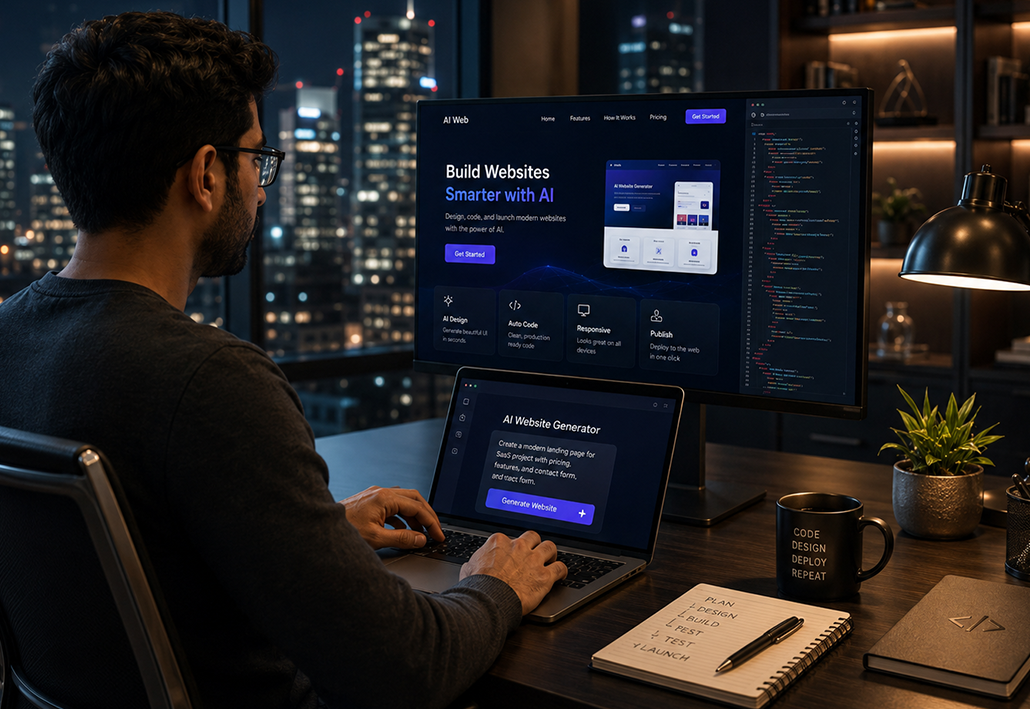
Top Web Development
Trends Businesses
Should Watch in 2026

Your website is either making you money or costing you money. There is no middle ground.
Most business owners don't realise their website is losing them until it's too late—a competitor outranks them, bounce rates spike, or a security breach wipes out months of trust they built with customers.
2026 is a pivotal year for web development. The tools are smarter, the stakes are higher, and the gap between businesses with a modern web presence and those running on outdated setups is becoming impossible to ignore.
This blog breaks down the web development trends that matter most this year—not as a tech lesson, but as a practical guide to what's costing you and what's worth investing in.
Is Your Website Working For You or Against You?
Before we get into trends, ask yourself these four questions honestly:
Does your site load in under 3 seconds? If not, you're losing a significant portion of visitors before they even see your offer. Studies show 53% of mobile users abandon a site that takes longer than 3 seconds to load.
Does your site rank on Google's first page for your core keywords? If not, the problem is likely technical performance, structure, or content gaps that a modern web setup would solve.
Have you audited your website's security in the last 12 months? If not, you're operating blind. Most small and mid-sized businesses don't discover a breach until significant damage is done.
Can your marketing team update content without calling a developer? If not, you're moving slower than your competitors and paying more than you should.
These aren't hypothetical problems. They're the exact issues businesses come to Webmaffia to fix—and they're all connected to the latest web development trends shaping 2026.
1. AI in Web Development — Your Competitors Are Already Using It
Let's be blunt: if your website was built or last updated by a team not using AI development tools, you're paying more and waiting longer than you need to.
AI in web development in 2026 doesn't mean robots replacing developers. It means developers using tools like GitHub Copilot, Cursor, and AI-powered testing platforms to build faster, catch bugs earlier, and ship cleaner code. The result for you as a business owner? Faster turnaround times, fewer costly revisions, and a more reliable end product.
What This Means in Real Terms for Your Business
A feature that used to take two weeks to build can now take three to four days. Bug detection that used to happen after launch—when it's expensive—now happens during development. UI prototyping that once required multiple rounds of back-and-forth can be visualised and tested in hours.
If you're currently locked into a slow, expensive development cycle with a team not using modern tools, you're not just wasting time—you're giving your competitors a head start on every product update, campaign landing page, and website improvement they ship before you.
At Webmaffia, AI-assisted development is already baked into our process. Our clients get faster builds, fewer bugs, and more value from every money spent on development.
2. Your Slow Website Is Killing Your Google Rankings
This is the one most businesses underestimate until they see the data.
Web performance optimization directly affects where you appear in Google search results. Google's Core Web Vitals—LCP (how fast your main content loads), CLS (how stable your page is as it loads), and INP (how quickly your page responds to user interaction)—are active ranking signals.
A slow website doesn't just frustrate users. It tells Google your site delivers a poor experience, and Google responds by ranking you lower. Lower rankings mean less organic traffic. Less traffic means fewer leads. It compounds quickly.
A 1-second delay in load time reduces conversions by up to 7%. For a business generating ₹10 lakhs a month through its website, that's ₹70,000 per second of unnecessary delay—every month.
What a Fast Website Actually Requires in 2026
Modern performance isn't about compressing a few images and calling it done. The businesses ranking at the top of Google are using edge computing, which serves their website from servers geographically close to each visitor. They're using modern image formats like WebP and AVIF that load in a fraction of the size of JPEGs. Their frameworks only load JavaScript where it's absolutely necessary, instead of dumping it all on the user at once.
Here's your immediate action: Open Google PageSpeed Insights right now, enter your website URL, and look at your LCP score. If it's above 2.5 seconds, you have a ranking problem that is actively suppressing your traffic. That number is costing you customers today.
Performance and SEO are inseparable in 2026. If you're not ranking where you should be, Webmaffia's SEO services start with a full technical audit so you know exactly what's holding you back and what it'll take to fix it.
3. Headless CMS — Why Your Content Team Is Probably Frustrated Right Now
Here's a scenario that plays out in hundreds of businesses every week: a marketing manager wants to update a homepage banner or publish a new blog post. They raise a request with the development team. The development team has three other priorities. The update goes live five days later.
That's not a people problem. That's an architecture problem—and headless CMS trends point to the solution.
What Headless CMS Actually Does for Your Business
A headless CMS separates your content management from your website's frontend. Your marketing team gets a clean, intuitive dashboard where they can update content, publish blogs, manage campaigns, and make changes without touching a single line of code or waiting on a developer.
Your development team, meanwhile, builds a fast, modern frontend that isn't constrained by the CMS's limitations. The two work independently—and both move faster as a result.
Platforms like Sanity, Contentful, and Storyblok have made this architecture accessible well beyond enterprise. Growing businesses are adopting headless CMS because it solves a real operational bottleneck of slow content cycles that cost marketing agility.
The additional benefit: your content flows seamlessly across your website, mobile app, and any other digital channel from a single source. No duplication, no inconsistency, no manual updates across multiple platforms.
If your marketing team is currently dependent on developers for routine content updates, that's a workflow that's costing you speed and money every single week. It's also one of the first things we assess when businesses approach Webmaffia for a website rebuild or migration.
4. Web Security — Most Businesses Discover the Problem Too Late
Cybercrime is projected to cost businesses worldwide $10.5 trillion annually by the end of this decade. And the uncomfortable truth is that small and mid-sized businesses are not too small to be targeted; they're actually preferred targets because their security is typically weaker.
The most dangerous web security threats in 2026 aren't dramatic movie-style hacks. They're quiet, systematic, and often exploiting vulnerabilities that could have been fixed with basic web security best practices.
What's Actually Happening Out There
Supply chain attacks are targeting the open-source packages that almost every modern website uses. Attackers compromise a widely-used package, inject malicious code, and it silently spreads across thousands of websites. You'd never know until the damage was done.
API vulnerabilities are growing as more websites adopt modern architectures. An improperly secured API endpoint can expose your entire customer database—and this is one of the most common critical vulnerabilities found in production websites today.
AI-generated phishing is getting frighteningly convincing. Attacks are now personalised, contextually accurate, and increasingly difficult to distinguish from legitimate communication. The human layer of your security matters as much as the technical layer.
What Every Business Should Have in Place Right Now
Multi-factor authentication on every admin panel—no exceptions. A Web Application Firewall, with Cloudflare being a strong, accessible starting point. Regular audits of every third-party tool and plugin your website uses, because each one is a potential attack vector. And penetration testing—not once a year as a compliance checkbox, but at least twice a year as a genuine security practice.
If you don't know when your website was last security-audited, that's your answer. A good web development partner builds security in from the start—not as an afterthought when something goes wrong.
5. No Code & Low Code — Speed Up Without Spiralling Costs
One of the most practical shifts in the latest web development trends is the maturity of no code low code development platforms.
Platforms like Webflow, Bubble, and Framer have reached a level of capability where serious business applications—not just landing pages, but customer portals, internal tools, and functional MVPs—can be built without traditional development.
Where This Actually Saves Your Business Money
Campaign landing pages that used to require a developer can now be built and published by your marketing team in hours. Product ideas that used to require months of development can be validated with a functional prototype before any significant engineering investment. Internal dashboards and workflow automations that previously sat in a backlog forever can be built by operations teams without touching the dev queue.
The important distinction: no code doesn't replace skilled development for complex, custom-built applications. What it does is free up your development budget for the work that genuinely requires it, while giving your non-technical teams real autonomy on the work that doesn't.
Businesses using no code and low code strategically—knowing what belongs where—are moving significantly faster and spending significantly less on routine digital work. If you're unsure which of your current projects actually need custom development, that's exactly the kind of clarity a digital strategy consultation can give you.
6. Accessibility — It's Now a Legal Requirement, Not Just Good Practice
The European Accessibility Act came into effect in mid-2025, requiring digital products and services to meet WCAG 2.1 AA accessibility standards. In the US, ADA-related web accessibility lawsuits continue to grow every year.
If your business operates in or sells to European markets, this is not optional. Non-compliant websites face real legal consequences.
But beyond compliance, accessible websites perform better on every metric that matters. They rank better in search because they're built on clean, semantic HTML. They convert better because they're navigable by a wider range of users. They load faster because well-structured code is more efficient by nature.
Accessibility and performance aren't competing priorities. They reinforce each other—and both contribute directly to your bottom line. If your current website was built without accessibility in mind, it's worth raising with your web development team before it becomes a legal or ranking issue.
7. Progressive Web Apps — The Mobile Experience You Can Afford
Native mobile apps are expensive to build, expensive to maintain, and require separate codebases for iOS and Android. For many growing businesses, that investment isn't justified—but a poor mobile experience is costing them customers every day.
Progressive web apps (PWAs) are the answer most businesses aren't considering yet.
A PWA looks and feels like a native app. Users can install it directly from their browser—no App Store, no submission process. It works offline through intelligent caching. It supports push notifications. And it runs from a single codebase that serves both web and mobile users.
Brands like Starbucks and Twitter Lite saw significant engagement improvements after PWA adoption. For businesses that need a strong mobile experience but can't justify a full native app build, PWAs deliver the outcome at a fraction of the cost—and they're increasingly part of what Webmaffia recommends for growing businesses that need mobile-first performance without a mobile-first budget.
What Should You Actually Do With This Information?
Reading about trends is easy. Knowing what to prioritise for your specific business is harder. Here's a clear framework:
If your site is slow or not ranking: Web performance optimization is your most urgent priority. It has the most direct, measurable impact on traffic and revenue. Start with a technical SEO audit to see exactly where you're bleeding rankings.
If your marketing team is bottlenecked by development: A headless CMS is the fix. It restores agility to your content operations and pays for itself quickly in speed and reduced developer dependency.
If you haven't audited your security recently: Stop and do it. The cost of a breach in data, reputation, and recovery vastly outweighs the cost of proper security hygiene.
If you're spending too much on development cycles: Ask whether your team is using AI-assisted development tools and whether no code platforms could handle any of your current build requirements. A digital strategy session can help you identify where you're over-investing and where you're under-investing.
If mobile experience is weak but a native app isn't in the budget: Evaluate a PWA. It's the most cost-effective way to close the gap.
These aren't trend decisions. They're business decisions with clear ROI. And making them with the right development partner makes every difference.
FAQ
How do I know if my website needs a performance overhaul?
Run your URL through Google PageSpeed Insights. If your LCP score is above 2.5 seconds or your overall score is below 70, your site is likely underperforming in search rankings and losing visitors before they convert. Webmaffia's SEO and performance audits will show you exactly where the losses are happening and what it takes to fix them.
What's the difference between headless CMS and a regular CMS like WordPress?
A traditional CMS ties your content to a specific frontend template. A headless CMS separates the two—your content lives in a backend that delivers it via API to any frontend or channel you build. The result is a faster website, greater developer flexibility, and a content team that can work independently without needing developer support for routine updates.
Is my website actually at risk of a cyberattack?
Yes, especially if it hasn't been audited recently. Small and mid-sized businesses are increasingly targeted because their security posture is typically weaker than enterprise. Third-party plugins, unsecured APIs, and outdated dependencies are the most common vulnerabilities. A basic security audit will tell you where you stand.
How much faster can AI-assisted development make a project?
Routine development tasks—building components, writing tests, debugging—are being completed 30–40% faster with AI-assisted tools. For a business, that translates to quicker launch timelines and more budget available for higher-value work. It's one of the reasons Webmaffia can deliver faster without cutting corners.
When does no code make sense vs. custom development?
No code works well for marketing sites, campaign pages, internal tools, and functional MVPs. Custom development is the right choice for complex applications with specific technical requirements, performance-critical systems, or deep integrations. Not sure which bucket your project falls into? That's exactly what a digital strategy conversation is for.
Your Website Should Be Your Best Salesperson. Is It?
The businesses winning online in 2026 aren't necessarily the ones with the biggest budgets. They're the ones with websites that load fast, rank well, convert consistently, and don't keep their teams waiting on a developer for every small update.
If any part of this blog described a problem you recognise in your own website, that's not a coincidence—these are the exact issues Webmaffia solves every day for businesses that are serious about their digital presence.
We don't just build websites. We build web infrastructure that works as a growth engine—fast, secure, scalable, and aligned with how your business actually operates.
If you want an honest assessment of where your website stands and what it's costing you—let's talk. No jargon, no hard sell. Just clarity on what needs to change and a plan to change it.
following blog articles.