Your Website Gets Traffic
But Zero Leads? Here's
the Real Reason Why
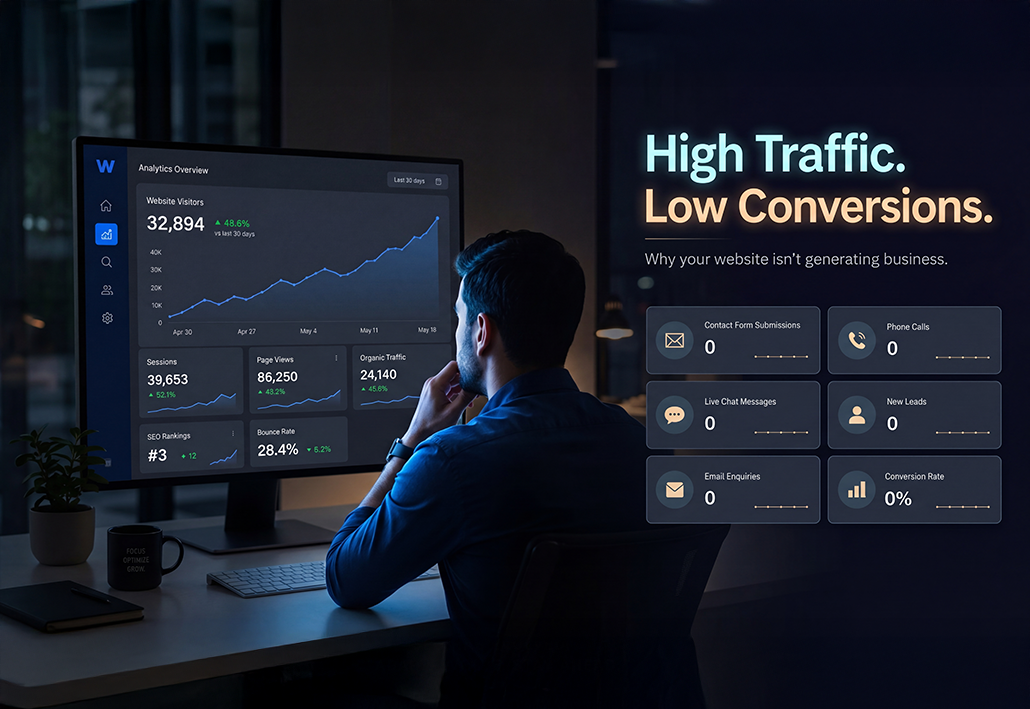
You open Google Analytics and the numbers look decent. Sessions are up. Pages are being visited. Maybe you even rank on the first page for a few keywords. But your inbox? Silent. Your phone? Not ringing. Your CRM? Empty.
If this is your reality right now, you are not alone. Thousands of businesses sit in exactly this position: a website that attracts visitors but refuses to convert them into enquiries, leads, or sales. The frustrating truth is that traffic and leads are two entirely different things, and confusing one for the other is one of the most expensive mistakes a business can make online.
This guide will show you exactly why your website traffic is not converting, what to look for, and how to fix it step by step.
Traffic Is a Vanity Metric. Leads Are the Real KPI
Let's get something straight from the beginning. Traffic numbers feel good. They go up, you feel like progress is being made. But if that traffic never turns into a conversation, a form submission, a call, or a purchase, it has delivered zero business value.
Leads are what pay salaries. Leads are what keep the lights on. Traffic is just the beginning of a journey, and far too many businesses are celebrating the start of that journey while ignoring the fact that nobody ever reaches the destination.
The shift you need to make is simple but fundamental: stop measuring how many people visit your site, and start obsessing over how many people take action when they get there.
What "Good Traffic" Actually Looks Like
Not all traffic is equal. Good traffic is made up of people who have a problem which your business solves, who are actively looking for a solution, and who are at a stage in their journey where they are willing to engage. Bad traffic inflates your analytics and fools you into thinking things are going well when they are not.
At Webmaffia, when we audit a new client's website, the first thing we look at is not how much traffic is coming in. It is whether the right traffic is coming in. That single distinction changes everything that follows.
Why Google Analytics Can Lie to You
Google Analytics will tell you how many people visited your site. It will not tell you why they left without doing anything. A low bounce rate sounds good until you realise visitors are clicking to a second page and then leaving without converting. A high time on page sounds great until you realise people are confused and searching for information that is not clearly presented.
Data without context is just noise. You need to understand the intent behind the numbers, not just the numbers themselves.
The Real Reasons Your Website Traffic Isn't Converting
Reason 1: You're Attracting the Wrong Audience
This is the single most common reason websites get leads from a website at zero rates. Your SEO might be working. Your ads might be running. But if the people arriving at your site are not your actual customers, nothing else matters.
If you run a premium B2B service but your content is attracting students doing research, you will get traffic and zero leads. The mismatch between who you are targeting and who you actually want to sell to is a silent conversion killer that no amount of design tweaking will fix. A well-defined digital strategy is what ensures your marketing actually reaches the people who are ready to buy, not just the people who are browsing.
Reason 2: Your Value Proposition Isn't Clear Above the Fold
When someone lands on your homepage, they make a decision in under five seconds. They ask themselves: is this for me, does this solve my problem, and can I trust these people?
If your homepage headline says something like "Welcome to Company Name" or "We deliver excellence in everything we do," you have already lost them. Generic, vague, or inward-focused messaging tells a visitor nothing about what you actually do or why they should care. Your value proposition needs to answer three things immediately: what you do, who you do it for, and what outcome you deliver.
Reason 3: There's No Obvious Next Step
Even if someone reads your entire website and loves what they see, if there is no clear and compelling invitation to take action, they will close the tab and move on with their day.
Call-to-action buttons that say "Learn More" or "Click Here" are essentially invisible. They create no urgency and communicate no value. Your CTA needs to tell people exactly what happens when they click it and what they will get as a result. "Get a Free Strategy Call," "Request a Custom Quote," "See How We Can Help" are specific, outcome-oriented, and give visitors a reason to act right now.
Reason 4: Your Website Speaks to Everyone and Converts No One
The temptation to cast a wide net is understandable. You do not want to exclude potential customers. But a website that tries to appeal to everyone ends up resonating with no one.
If your messaging is so broad and generic that it could apply to any business in your industry, it will not feel relevant to the specific person reading it. People convert when they feel like a website was made for them. Specificity builds connection. Connection builds trust. Trust drives leads.
Reason 5: Trust Signals Are Missing or Buried
Would you hand your money to a complete stranger with no references, no reviews, and no proof of past work? Of course not. Yet many business websites ask visitors to enquire without giving them any reason to feel confident doing so.
Trust signals are the elements of your website that reduce risk and build credibility. They include client testimonials, case studies, awards, certifications, client logos, team photos, and verified reviews. If these are missing, hidden on an inner page, or outdated, your visitors have no foundation for trust, and without trust, there are no leads.
Reason 6: Your Page Speed Is Silently Killing Conversions
Every additional second it takes for your website to load costs you visitors. Research consistently shows that a one-second delay in page load time can reduce conversions significantly. On mobile, the damage is even worse.
Users are impatient and their expectations are higher than ever. If your site takes more than three seconds to load, a substantial portion of your visitors will leave before they have seen a single word of your content. Your SEO might get them to the door, but a slow website slams it in their face. This is a core part of what the design and development team at Webmaffia audits and fixes for every client we work with.
Reason 7: You're Ranking for Informational Keywords, Not Buyer Keywords
There is a fundamental difference between someone who searches "what is digital marketing" and someone who searches "digital marketing agency for e-commerce brands." The first person wants to learn. The second person wants to hire.
If your website ranks well for informational queries, you will get a lot of traffic from people who are in research mode. These visitors are not ready to buy. They may never be ready to buy from you. And they will leave without converting.
How to Find Out Exactly Where Your Website Is Losing Leads
Check Your Bounce Rate by Landing Page
Pull up your Google Analytics and look at the bounce rate for each of your key landing pages individually. A high bounce rate on a service page or contact page is a red flag. It means people are arriving and immediately deciding the page is not what they were looking for.
Look for patterns. If multiple pages have high bounce rates, the problem is likely your traffic source or your messaging. If one specific page has an unusually high bounce rate, the problem is likely that page itself.
Use Heatmaps to See Where Users Drop Off
Heatmap tools like Hotjar or Microsoft Clarity show you exactly where visitors are clicking, how far they are scrolling, and where they are abandoning your pages. If users are consistently dropping off before they reach your CTA, you know your CTA needs to move higher up the page. If nobody is clicking a button you thought was obvious, you know something about its design or copy is failing.
Audit Your CTA Placement and Copy
Go through every key page on your website and ask yourself four questions for each one. Is there a CTA on this page? Is it visible without scrolling? Does it tell me exactly what happens when I click it? Does it give me a reason to act now?
Most websites fail at least two of those four tests on most pages.
Run a Keyword Intent Audit
Log into Google Search Console and look at the search queries that are bringing people to your site. Are these queries from people who are trying to learn something, or from people who are looking to hire, buy, or engage a service?
If the overwhelming majority of your traffic is coming from informational searches, you have identified a major part of your lead generation problem. Building an SEO strategy that targets buyer-intent keywords rather than just high-volume informational terms is what separates websites that rank from websites that actually generate business.
Your Design Might Be the Problem, Not Your SEO
Cluttered Layouts That Confuse Visitors
A website that tries to say everything at once ends up saying nothing. Cluttered layouts, too many navigation options, competing visual elements, and walls of text all create cognitive overload. When a visitor feels overwhelmed, they do not stay to figure it out. Good web design is not about making something look pretty. It is about making it feel effortless to use, guiding the visitor naturally toward the action you want them to take.
Mobile Experience That Drives Users Away
More than half of all web traffic now comes from mobile devices. If your website is difficult to use on a phone, with buttons too small to tap, text too small to read, and forms painful to fill out, you are actively driving away the majority of your potential leads.
A mobile-first approach is no longer optional. It is essential. This is not just a design consideration. It is a revenue consideration.
Forms That Feel Like a Government Application
Nothing kills conversion intent faster than a form that asks for too much too soon. If your contact form has eight fields asking for budget, company size, and project timeline before a visitor has even decided if they trust you, they will abandon it.
Start simple. Name, email, and one line about what they need. You can gather more information once the relationship has begun.
Why Visitors Don't Trust Your Website Enough to Enquire
No Social Proof: Missing Reviews, Testimonials, or Case Studies
Social proof is one of the most powerful forces in human decision-making. People trust the opinions of others who have already made the same decision they are considering.
If your website has no reviews, no testimonials, no case studies, and no client logos, visitors have no evidence that anyone has ever hired you and had a good experience. In a competitive market, this is often enough to send them straight to a competitor who does have that evidence.
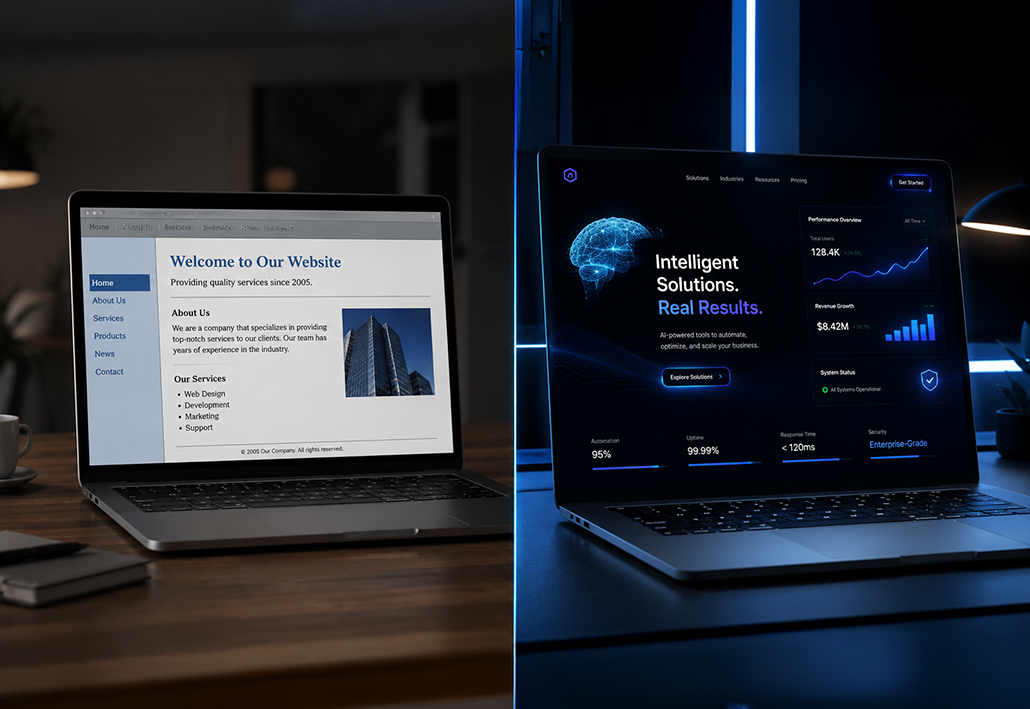
Outdated Design and Stale Content Equal Lost Credibility
An outdated website design signals one of two things to a visitor: either this business does not care about its online presence, or this business is not doing well enough to invest in it. Neither impression generates confidence.
Blog posts from three years ago, copyright footers showing an old year, or references to events that are now outdated all quietly undermine your credibility in ways that are easy to miss but powerfully damaging. Fresh, relevant content marketing is not just about ranking. It is about signalling to every visitor that this is a business that is active, current, and worth their attention.
No Human Face: People Buy from People, Not Websites
One of the fastest ways to build trust online is to show the human beings behind the business. A team page with real photos, names, and brief bios transforms an anonymous website into a business run by real people. It makes the prospect of getting in touch feel less intimidating and more personal.
If your website has no faces, no personalities, and no story, you are making it harder for visitors to connect with you, and connection is what converts.
You're Ranking, But for the Wrong Stage of the Funnel
Informational vs. Transactional vs. Commercial Keywords
Understanding keyword intent is one of the most important concepts in digital marketing, and one of the most widely ignored in practice.
Informational keywords are used by people who want to learn. "How does SEO work" is an informational search. These people are not looking to hire anyone right now.
Commercial keywords are used by people who are researching their options. "Best SEO agencies in Mumbai" falls into this category. These people are getting closer to a decision.
Transactional keywords are used by people who are ready to act. "Hire SEO agency" or "digital marketing company contact" are transactional searches. These people have buying intent right now.
Most websites rank for informational keywords and then wonder why visitors do not convert. Those visitors were never ready to buy.
How to Map Content to Buyer Intent
Each stage of the buying journey deserves its own content strategy. Your blog and resource articles should serve informational searchers and introduce them to your brand. Your service pages and comparison content should serve commercial searchers who are weighing their options. Your landing pages, case studies, and direct CTAs should serve transactional searchers who are ready to engage.
When your content aligns with buyer intent at every stage, your traffic does not just grow. It starts converting.
The Blog Traffic Trap: Readers Are Not Buyers
Blog traffic is the hardest traffic to convert into leads. People reading a blog post are almost always in information mode, not buying mode. This does not mean content marketing is ineffective. It means blog traffic needs to be managed with lead magnets, email capture, and nurture sequences to convert readers over time, rather than expecting them to fill out a contact form after reading a single article.
How to Turn Your Traffic Into Leads: A Step-by-Step Fix
Step 1: Audit Your Traffic Sources and Intent Alignment
Before you change anything on your website, understand who is currently visiting it and why. Use Google Search Console to review your top queries. Use Google Analytics to identify your top traffic sources. Map each source to a level of buyer intent.
This audit will show you where the disconnect is happening, whether you are attracting the wrong visitors entirely or whether the right visitors are arriving but your website is failing to convert them.
Step 2: Rewrite Your Homepage Value Proposition
Your homepage headline and subheading are the most important copy on your entire website. Rewrite them with one goal: make it instantly clear who you help, what you help them do, and what outcome they can expect. Small changes in wording can produce significant improvements in conversion rate.
Step 3: Add Lead Magnets for Non-Ready Buyers
Not every visitor is ready to enquire right now, but that does not mean you should let them leave empty-handed. A lead magnet is a free, valuable resource you offer in exchange for an email address. It could be a guide, a checklist, a template, or a free audit.
Lead magnets capture the interest of visitors who are not yet ready to buy but are open to learning more, allowing you to continue the relationship until they are ready to convert.
Step 4: Fix Your CTA
Every page on your website should have one primary call to action. Not three, not five, one. When visitors have too many options, they often choose none. Decide what you want each page to achieve and build every element of that page around that single goal.
Step 5: Build Trust Signals Into Every Key Page
Do not relegate your testimonials and case studies to a dedicated page that most visitors will never find. Bring them into your service pages, your homepage, and your contact page. Put social proof right next to the point where you are asking someone to take action. If someone is hovering over your contact button and they can see three glowing client testimonials next to it, their confidence to click increases dramatically.
Step 6: Create Bottom-of-Funnel Landing Pages for Buyer Keywords
Build dedicated landing pages for your most commercial and transactional keywords. These pages should be laser-focused on a single service, for a specific audience, with a single strong CTA and supporting social proof. These pages will not get the same volume of traffic as your blog posts, but they will convert at a dramatically higher rate because the people finding them are ready to engage.
Quick Wins That Can Improve Lead Generation This Week
Add a Click-to-Call Button on Mobile
On mobile, make it effortless for someone to call you. A prominent click-to-call button removes friction and captures leads who are ready to talk right now. This single change can produce immediate results for local and service businesses.
Put a Lead Form Above the Fold
If getting enquiries is your primary goal, do not hide your contact form at the bottom of the page. Put a simple, short form above the fold on your most important pages. The easier it is to reach you, the more people will.
Replace Generic CTAs with Specific Ones
Go through your website right now and replace every instance of "Learn More," "Click Here," and "Submit" with something specific and outcome-driven. "Get My Free Quote," "Book a 30-Minute Call," "See Our Work" are all significantly more effective because they tell the visitor exactly what they are getting.
Add a Live Chat or WhatsApp Widget
Many people who visit your website would enquire if the process felt more immediate and less formal. A live chat widget or a WhatsApp button gives them a low-friction way to start a conversation. Even if you cannot respond instantly, capturing that message is infinitely better than losing that visitor forever. This is one of the quick implementation wins the team at Webmaffia recommends across social media and website touchpoints alike, because meeting your audience where they are comfortable is always the right move.
FAQ
Why does my website get visitors but no enquiries?
The most common reasons are misaligned traffic intent, a weak or missing value proposition, poor CTA placement, lack of trust signals, and slow page speed. Most businesses suffer from a combination of two or three of these issues simultaneously. A structured audit of your traffic sources, landing pages, and conversion elements will usually identify the primary culprits quickly.
What is a good website conversion rate?
For most B2B service businesses, a conversion rate of 2 to 5 percent is considered healthy for general traffic. Landing pages built for specific high-intent keywords can convert at 5 to 15 percent or higher. If your site is converting at under 1 percent, there are almost certainly structural issues that need addressing.
How do I convert website traffic into leads?
Start by ensuring your traffic is made up of the right people. Then make sure your value proposition is immediately clear, your trust signals are prominent, your CTAs are specific and compelling, and your forms are short and easy to complete. Fix your page speed, optimise for mobile, and create dedicated landing pages for your most important services.
Does more traffic always mean more leads?
No. This is one of the most dangerous misconceptions in digital marketing. More traffic from the wrong sources will produce more visitors and zero additional leads. Quality of traffic matters far more than volume.
What's the fastest way to improve website lead generation?
The fastest wins typically come from fixing your CTA copy, adding a form above the fold on your key pages, improving your homepage headline, and adding a click-to-call button on mobile. These changes require no additional traffic and can produce results within days. For sustained improvement, a full conversion audit combined with a targeted SEO and content strategy is the most reliable path forward.
Stop Counting Visitors. Start Counting Conversations.
Traffic without leads is like footfall in a shop where nobody can find the checkout. The problem is rarely that people are not interested. The problem is that your website is not doing its job of guiding them from interest to action.
Every business that struggles with this problem deserves a clear, honest answer about what is going wrong and a practical roadmap to fix it. That is the work that Webmaffia was built to do. Whether it is an SEO strategy built around buyer intent, a website rebuilt from the ground up to convert, or an influencer marketing campaign that puts your brand in front of the right audience at the right moment, the goal is always the same: turning your digital presence into a pipeline that actually delivers results.
If your website is getting traffic but not generating leads, the answer is not more traffic. It is a smarter strategy. And that conversation starts here.
following blog articles.