What Is an AI Agent? How They Can Make Work More Productive
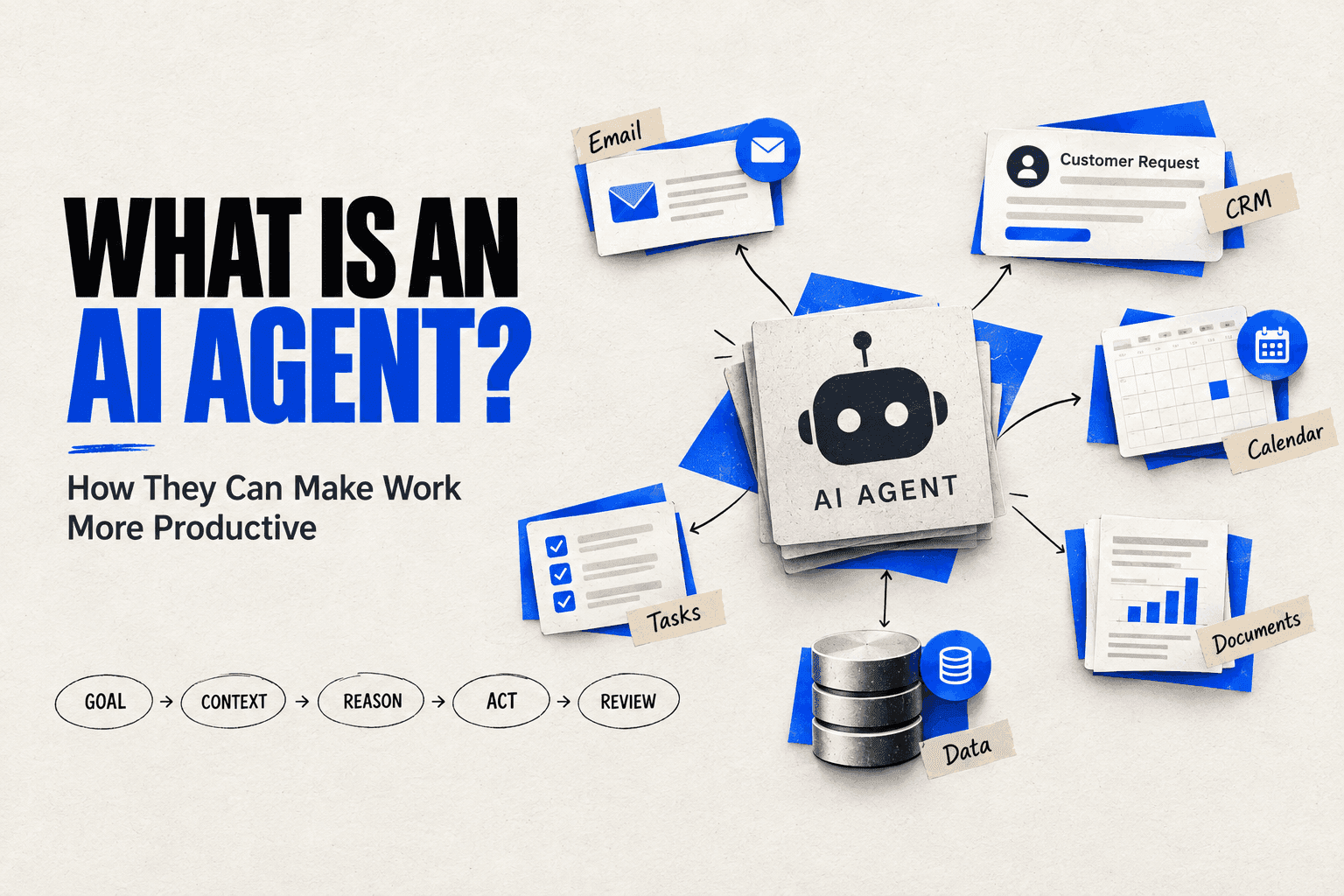
So, what is an AI agent? In simple terms, it is a software system that works toward a goal. It reads information, decides what to do next, uses tools or connected systems and carries out multi-step tasks with some degree of independence. A standard chat tool answers questions. An agent can also take action.
That is why businesses and employees are paying attention. Sorting requests, updating records and compiling reports eat up hours every week and agents can take on parts of that work. This guide explains how AI agents work, how they differ from related technologies, where they help, and how to start sensibly.
What Is an AI Agent?
The AI agent meaning comes down to three things: a goal, the ability to decide and the ability to act. Give an agent an objective like "qualify this inbound lead" and it can review the enquiry, check your CRM, assess fit and pass a summary to a salesperson.
Autonomy varies. Some agents suggest actions and wait for approval. Others handle routine tasks alone within set limits. Not every product built on a language model counts as an agent. A box that drafts emails is generative AI and it only becomes agent-like when it can pursue a goal and act across systems.
How Do AI Agents Work?
Most agents follow a similar loop:
- Goal: a person assigns a task, or a trigger such as a new email starts one.
- Context: the agent gathers relevant information, like documents, past conversations or database records.
- Reasoning: a model, often a large language model, plans the steps.
- Action: the agent uses tools such as a CRM, calendar, search or email to do the work.
- Review: it checks the result, adjusts, or hands over to a human.
The system around the model matters as much as the model. Permissions, memory and integrations decide how useful and safe an agent is.
What Are the Different Types of AI Agents?
Classic AI theory describes simple reflex agents (fixed rules), goal-based agents (planning toward an outcome) and learning agents (improving from feedback). In business, a more practical split is by scope: single-task agents such as ticket routing, multi-step workflow agents and multi-agent systems where several agents handle different parts of one process.
AI Agents vs. Chatbots, Automation and Generative AI
AI Agents vs. Chatbots
A chatbot mainly converses, often from scripts or a knowledge base. An agent can go further: check an order in your system, apply a refund within policy and log the case.
AI Agents vs. Traditional Automation
Traditional automation follows fixed rules: if this happens, do that. It is dependable for predictable processes but struggles when inputs vary. Agents can interpret messy inputs, like a free-text email and choose between actions. Many good setups combine both.
AI Agents vs. Generative AI
Generative AI creates content such as text, images or code. It is a capability an agent may use. The agent adds goals, tools and multi-step action on top.
How Can AI Agents Make Work More Productive?
The gains come from removing friction, not from replacing people. Realistic examples include:
- Repetitive tasks: data entry, tagging, scheduling and follow-up reminders.
- Everyday time savers: summarizing long threads, drafting first versions and pulling information from several places.
- Workflow efficiency: fewer handoffs and less waiting between steps.
- Higher-value work: people spend less time on admin and more on judgment, relationships and creative problem solving.
- Faster decisions: teams get organized information sooner.
Results depend on the workflow, data quality and how well the agent is set up.
AI Agent Use Cases in the Workplace
These are examples of what is possible, not guaranteed outcomes:
- Customer service: summarizing inquiries, routing tickets and drafting replies for review.
- Marketing: assisting with briefs, research and repurposing in a content marketing strategy, or gathering keyword data for SEO services.
- Sales: qualifying leads, updating CRM records and preparing meeting notes.
- Research and analysis: collecting sources, comparing data and preparing draft reports.
- Operations: handling invoices, approvals and other administrative processes.
- Internal support: answering employee questions about policies or documents.
How AI Agents Can Help Businesses Automate Workflows
Agents are most valuable when connected to the tools your team already uses. One agent might read a new inquiry in email, look up the customer in the CRM, check inventory, draft a response and create a follow-up task. That is a multi-step workflow crossing four systems.
This reduces manual copying between tools, shortens response times and lets processes handle more volume without adding the same amount of admin work. Quality still depends on clean data and well-defined rules.
Benefits of AI Agents for Businesses
Well-implemented agents can reduce repetitive work, speed up responses, keep processes more consistent and free employees for better work. There are limits. Agents can make mistakes, misread context or act on poor data. They are not suited to every workflow and cost savings are not automatic.
How Can Businesses Start Using AI Agents?
- Identify repetitive, time-consuming tasks. Ask teams where hours disappear each week.
- Choose one use case. Start with something frequent, low-risk and easy to measure.
- Integrate with existing workflows. An agent that sits outside daily tools rarely gets used.
- Define oversight and security. Decide what the agent can access, which actions need human approval and how activity is logged.
- Measure impact. Track time saved, response speed and error rates, then adjust.
Aligning this with a broader digital strategy helps ensure agents support real business goals rather than becoming isolated experiments.
When Should a Business Consider an AI Agent?
Consider one when work is repetitive, involves several tools and follows patterns that still need some judgment. Volume matters too. If your team handles many similar requests, the payoff is clearer. If a process is rare, highly sensitive or poorly documented, fix that first.
The Future of AI Agents in the Workplace
Expect agents to become more common as assistants inside everyday software, handling routine steps while people supervise. Their reach will likely grow, but trust will depend on governance, transparency and sensible limits on what they can do alone.
Frequently Asked Questions About AI Agents
What Is an AI Agent in Simple Terms?
It is software that can work toward a goal by deciding what to do and using tools to do it, rather than just replying to prompts.
How Does an AI Agent Work?
It takes a goal, gathers context, plans steps with a model, acts through connected tools and reviews the result.
What Can AI Agents Do?
They can research, summarize, route requests, update records, draft content and trigger actions across systems, depending on how they are set up.
What Is the Difference Between an AI Agent and a Chatbot?
A chatbot mostly holds conversations. An agent can also take actions in other systems to complete a task.
Can AI Agents Improve Workplace Productivity?
Yes, particularly for repetitive, multi-step work. The improvement depends on the use case, integration quality and human oversight.
What Tasks Can AI Agents Automate?
Common candidates are data entry, ticket triage, lead qualification, report preparation and internal information lookup.
How Are AI Agents Used in Businesses?
Mostly in customer support, sales, marketing, operations and research, often alongside existing software.
How Can a Business Implement AI Agents?
Start with one well-defined task, connect it to current tools, set clear approval and security rules and measure the results.
Conclusion: Using AI Agents to Build More Productive Workflows
Understanding what an AI agent is makes it easier to see where it fits: a goal-driven system that can act across your tools, best used for repetitive, multi-step work. The value comes from choosing the right use cases and keeping humans in charge of important decisions.
If you are exploring where agents could help your team, contact WebMaffia to discuss your workflows and the practical next steps.
following blog articles.