AI Automation vs Agentic AI: Choosing the Right Intelligence Layer for Your Business
Businesses are adopting AI faster than they can evaluate it. Budgets get approved before anyone asks the real question: does this task need automation or intelligence?
That confusion is expensive. Teams deploy complex AI agents for tasks a simple rule-based system could handle, or they stick with rigid automation when a workflow actually needs reasoning and coordination.
The smarter approach isn't chasing whatever technology is trending. It's identifying the right intelligence layer for each business need, whether that's AI automation or agentic AI. This guide breaks down the difference, when to use each, and how to build a system that scales with your business instead of against it.
AI Automation vs Agentic AI: What's the Difference?
What Is AI Automation?
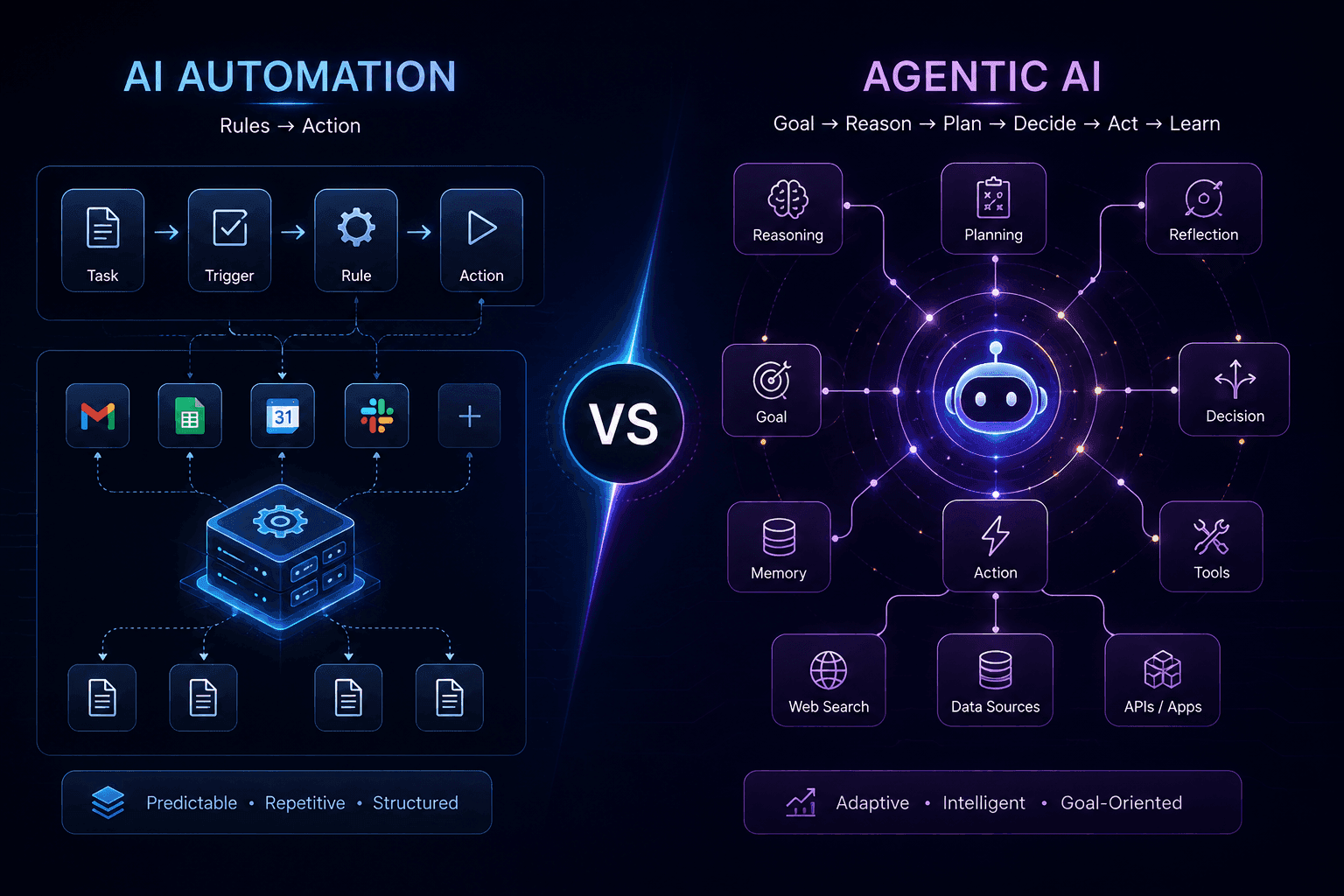
Definition: AI automation combines rule-based automation with AI capabilities like language understanding, prediction, or pattern recognition. It executes predefined tasks intelligently, but within fixed boundaries.
How it works: A trigger initiates a task, AI processes the input, and a predetermined action follows. There's intelligence involved, but not independent decision-making.
Best use cases:
• Categorizing support tickets
• Personalizing email campaigns
• Extracting data from documents
• Generating first-draft content
Key benefits: AI automation is faster to deploy, easier to manage, and delivers reliable, predictable outcomes for well-defined tasks.
What Is Agentic AI?
Definition: Agentic AI refers to AI systems, or AI agents, that can plan, make decisions, and execute multi-step tasks with minimal human intervention, adjusting their approach based on new information.
How AI agents work: An agent breaks a broader goal into smaller steps, pulls data from multiple tools or systems, evaluates outcomes, and decides the next action, much like an employee working through an open-ended project.
Key capabilities:
• Autonomous decision-making
• Cross-platform task execution
• Continuous learning from outcomes
• Goal-oriented reasoning
Business advantages: Agentic AI handles complexity that traditional automation can't, reducing manual coordination across departments and systems.
AI Automation vs Agentic AI: A Side-by-Side Comparison
The two technologies differ across several dimensions:
• Purpose: AI automation executes defined tasks efficiently. Agentic AI achieves broader goals through independent action.
• Decision-making capability: AI automation follows logic set in advance. Agentic AI evaluates situations and decides the next step.
• Human involvement: AI automation typically needs review at key checkpoints. Agentic AI needs oversight, not constant control.
• Workflow complexity: AI automation suits single-step or linear tasks. Agentic AI manages multi-step, cross-system workflows.
• Learning and adaptability: AI automation rarely adapts beyond its initial setup. Agentic AI adjusts its approach as new data comes in.
• Ideal business use cases: AI automation fits repetitive operational tasks. Agentic AI fits complex, judgment-driven processes.
When Should Your Business Choose AI Automation?
AI automation is the right fit when tasks are repetitive but benefit from a layer of intelligence. Common scenarios include:
• Repetitive business processes like data entry or report generation
• Customer support automation, such as auto-categorizing and routing tickets
• Marketing workflows, including audience segmentation and campaign personalization
• CRM updates, keeping contact and deal records accurate without manual input
• Invoice processing, extracting and validating data automatically
• Internal approvals, routing requests based on predefined criteria
If the process follows a clear, consistent pattern, AI automation delivers strong ROI without added complexity.
When Is Agentic AI the Better Choice?
Agentic AI earns its cost when workflows involve multiple steps, systems, or decisions. It fits well in:
• Multi-step business workflows that span several departments
• Sales assistants that qualify, prioritize, and follow up with leads independently
• AI-powered project management, adjusting timelines and resources based on progress
• IT operations, detecting and resolving issues across systems
• Customer success, proactively identifying at-risk accounts and taking action
• Cross-platform decision-making, where an outcome in one tool affects the next step in another
How to Build the Right Intelligence Layer for Your Business
A practical, low-risk framework works best:
1. Identify repetitive tasks across your teams and workflows.
2. Implement AI automation wherever clear rules already exist.
3. Introduce agentic AI for workflows that require reasoning across multiple steps or systems.
4. Keep humans involved for strategic, high-stakes decisions.
5. Scale gradually based on measurable outcomes rather than assumptions.
A clear digital strategy makes this process far more effective, since it aligns technology choices with actual business goals instead of guesswork.
Common Mistakes Businesses Make When Adopting AI
• Confusing AI automation with agentic AI, leading to mismatched expectations
• Implementing AI without clear business objectives, resulting in tools nobody fully uses
• Overengineering simple workflows with agentic systems that add unnecessary cost
• Ignoring data quality and governance, which undermines both automation and agents
• Expecting AI to replace human expertise entirely, when the strongest results come from AI supporting human judgment
Frequently Asked Questions
What is the main difference between AI automation and agentic AI?
AI automation executes predefined tasks using rules and AI capabilities like language processing. Agentic AI plans, decides, and executes multi-step tasks independently, adapting as new information comes in.
Can AI automation and agentic AI work together?
Yes. AI automation handles repetitive, well-defined tasks, while agentic AI manages the complex decision-making and coordination layered on top of those tasks.
Which businesses benefit the most from agentic AI?
Businesses with multi-step, cross-departmental workflows, such as sales operations, IT management, or customer success, see the strongest returns from agentic AI.
Is AI automation enough for small and medium-sized businesses?
For many SMBs, yes. AI automation covers most repetitive operational needs. Agentic AI becomes valuable once workflows grow more complex or span multiple systems.
How can businesses transition from AI automation to agentic AI?
Start by mastering AI automation for repetitive tasks, then identify workflows where decisions depend on multiple variables or systems. Those are strong candidates for agentic AI.
Conclusion
AI automation and agentic AI aren't competing technologies, they're complementary. Businesses should begin by automating repetitive tasks with AI automation, then adopt agentic AI where workflows require reasoning, decision-making, and coordination across multiple systems.
Choosing the right intelligence layer improves efficiency, reduces operational costs, and builds a scalable foundation for future growth. If your business needs help mapping this out, WebMaffia supports organizations through digital strategy, SEO, and content marketing that align technology with real business outcomes.
Not sure where your business stands? Talk to WebMaffia and build a roadmap that fits your actual workflows, not just the latest AI trend.
following blog articles.