How AI Crawlers Read Your Website And Why Most Businesses Have No Idea
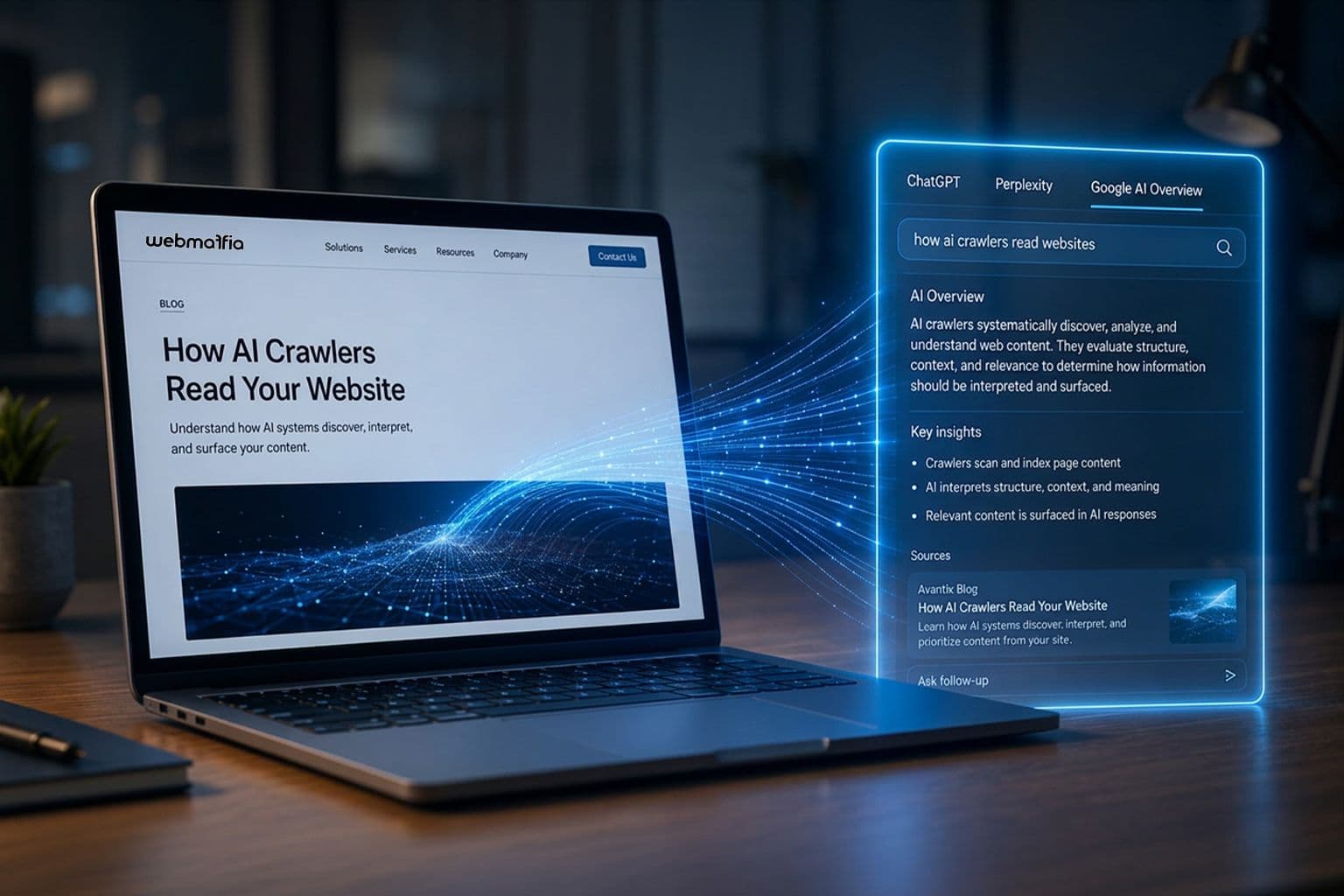
Search is changing faster than most businesses can keep up with. For years, ranking on Google meant optimizing for one type of crawler with a fairly predictable set of rules. That world is shifting.
AI search engines like ChatGPT, Perplexity, and Google's AI Overviews now rely on AI crawlers to discover and interpret website content before it ever reaches a user. If your website isn't built for these systems to access and understand, you could be invisible in the next generation of search, even if you rank well on Google today.
What Are AI Crawlers and How Do They Read Websites?
AI crawlers, sometimes called AI bots or AI search crawlers, are automated systems that scan websites to collect and process content. They work in a similar way to traditional search engine bots, following links, reading pages, and indexing information.
The difference lies in what happens next. Instead of simply storing pages for a results list, AI web crawlers try to extract meaning. They look at headings, body content, links, and page structure to figure out what a page is actually about.
This is why AI website crawling depends so heavily on crawlability. If a crawler cannot access or parse your content properly, it cannot understand it, and it certainly cannot recommend it.
How AI Crawlers Understand Your Website Content
Once an AI crawler can access a page, understanding is the next challenge. Several elements influence how AI crawlers read websites:
- Clear headings and page hierarchy that signal what each section covers
- Relevant, readable content written for humans first
- Internal links that show relationships between pages
- Metadata like title tags and descriptions
- Structured data that labels entities and information explicitly
- Context between pages, helping crawlers connect related topics
When these elements work together, AI crawlers understand web pages more accurately. When they're missing or inconsistent, even well-written content can be misread or ignored entirely.
Why Most Websites Are Not AI-Ready
Many websites that perform reasonably well in traditional search still struggle with AI search optimization. Common issues include:
- Poor website structure with unclear navigation and inconsistent headings
- Important content hidden behind JavaScript, which some crawlers cannot render
- Weak internal linking, leaving pages isolated from related content
- Poor crawlability caused by broken links or slow-loading pages
- Incorrect robots.txt configuration that unintentionally blocks key pages
- Missing schema markup, leaving entities and services unlabeled
- Thin or unclear content that doesn't fully answer user questions
Website structure affects AI crawlers more than many businesses realize. A site can be technically live and still be practically invisible to AI systems trying to make sense of it.
How to Optimize Your Website for AI Crawlers
Optimizing for AI crawlers isn't about chasing a new trend. It's about strengthening the fundamentals that make a website genuinely understandable.
Create a Clear Website Structure
Use a logical heading hierarchy, from H1 down to H3, so crawlers can map out how content is organized. Keep URLs descriptive and consistent, and design navigation that reflects how your services or topics relate to one another. A well-planned website design and development approach makes this structure easier to build in from the start, rather than fixing it later.
Make Content Easy for AI to Understand
Write in a direct, context-rich way rather than stuffing keywords. Answer the question a reader is likely searching for, early and clearly. AI systems favor content that explains concepts fully rather than pages built purely to rank. A thoughtful content marketing strategy helps ensure this depth is consistent across every page, not just a handful of blog posts.
Implement Structured Data and Schema Markup
Schema markup helps search engines and AI systems interpret entities like your organization, services, articles, and offers. It removes ambiguity, telling crawlers exactly what a piece of content represents rather than leaving them to guess.
Check Robots.txt and Crawlability
Review your robots.txt file regularly. It's easy to accidentally block important pages, especially after a website redesign or migration. If a page matters to your business, make sure crawlers can actually reach it.
Strengthen Internal Linking
Internal linking helps AI crawlers understand how your pages relate to each other. Linking a blog post to a relevant service page, for example, gives crawlers useful context about your expertise and offerings.
AI Crawlers vs. Google Crawlers: What Businesses Should Know
AI crawlers and Google crawlers aren't entirely different creatures. Both need to access and read your content before anything else can happen.
The distinction is what comes after crawling. Traditional search engines primarily crawl and index content to generate a list of results. AI-driven search experiences go a step further, interpreting and synthesizing information to generate direct answers.
That means being crawlable and indexable by Google doesn't automatically guarantee your content will be well understood or surfaced by AI systems.
How AI Crawler Optimization Impacts AI Search Visibility
The connection is simple: crawlability leads to understanding, and understanding leads to visibility.
This is the core idea behind AI SEO and Generative Engine Optimization (GEO). Businesses that want to appear in AI-generated answers need websites that are accessible, understandable, authoritative, and clearly structured, for both traditional search engines and AI-driven discovery.
Authority signals matter here too. A consistent social media marketing presence and credible influencer marketing mentions add trust signals that AI systems often weigh alongside on-site content when deciding what to surface.
Improving AI search visibility isn't a separate project from good SEO. It's an extension of it.
Frequently Asked Questions About AI Crawlers
What are AI crawlers?
AI crawlers are automated bots used by AI search engines to discover, read, and process website content, helping generate accurate, context-aware answers for users.
How can I optimize my website for AI crawlers?
Focus on crawlability, clear content structure, internal linking, schema markup, and accessible, well-organized pages that clearly communicate what your website offers.
Does robots.txt affect AI crawlers?
Yes. Robots.txt provides crawling instructions to bots, including AI crawlers. Businesses should regularly review it to confirm important pages aren't unintentionally restricted.
Is AI SEO different from traditional SEO?
AI SEO builds on the same foundation as traditional SEO, technical health, content quality, and structured data, while also accounting for how AI systems interpret and generate answers.
Conclusion: Make Your Website Understandable to AI
AI search optimization isn't a separate discipline from SEO. It's the next layer of it.
A website today needs to be more than searchable. It needs to be understandable, by people and by the systems that increasingly stand between people and information.
Improving technical accessibility, content structure, internal linking, and structured data builds a stronger foundation for both traditional search and emerging AI search experiences.
If you're unsure how AI-ready your website really is, WebMaffia can help. From digital strategy to SEO, our team works with businesses to build websites that are structured, crawlable, and genuinely built to be understood, wherever search is headed next. Get in touch to see where your website stands.
following blog articles.