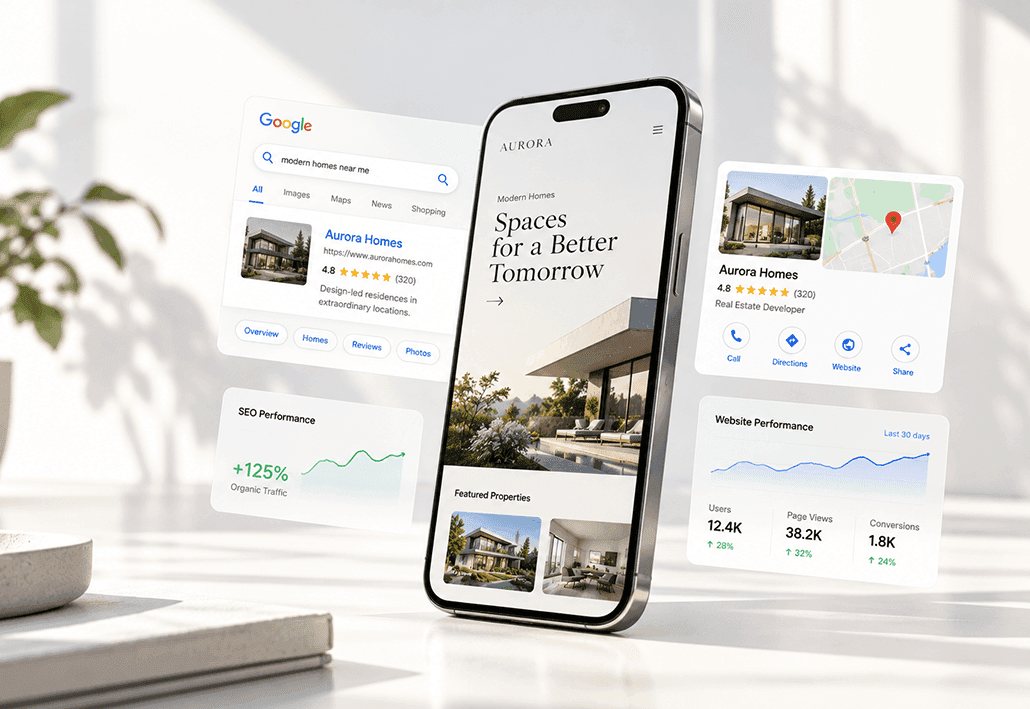
What Is Answer Engine Optimization (AEO) and Why It Matters
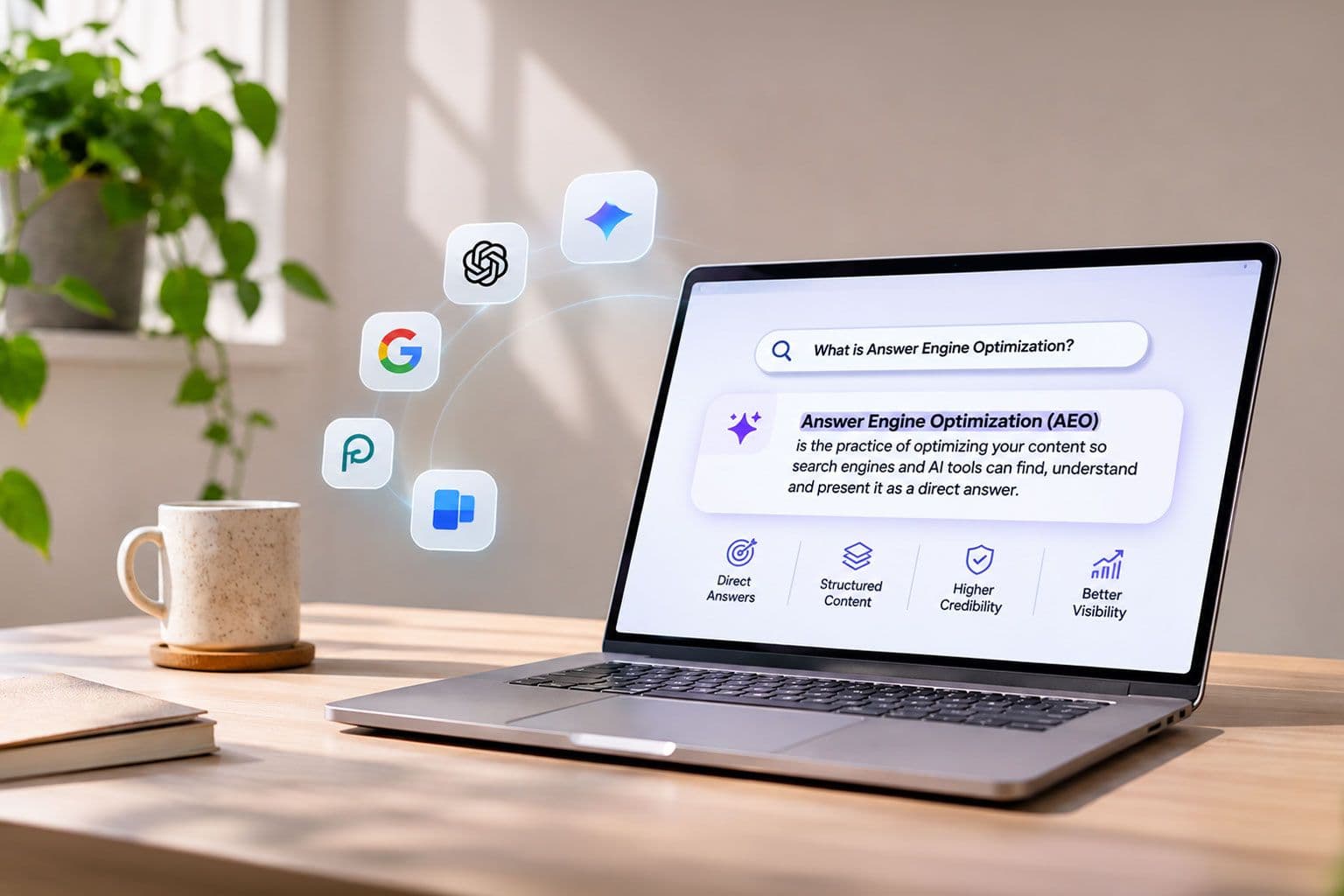
Answer engine optimization (AEO) is the practice of structuring your content so search engines and AI tools can find it, understand it and present it as a direct answer. This guide is for business owners and marketers who want to stay visible as people ask questions to Google, ChatGPT and Perplexity instead of scrolling through links. You will learn how AEO works, how it differs from SEO and how to start.
What Is Answer Engine Optimization (AEO)?
AEO is the practice of structuring content so that search engines and AI tools can find, understand and present it as a direct answer to a question. Instead of only competing for a ranking position, you compete to be the source an answer engine quotes, summarises, or cites.
AEO meaning in simple terms
Think of it as writing for the question, not just the keyword. If someone asks, "How long does a website redesign take?", an answer engine looks for a page that states the answer clearly, backs it up and comes from a trustworthy source. AEO is the work of making your page that source.
What counts as an "answer engine"?
Any system that responds to a query with an answer rather than a list of links qualifies:
- Google AI Overviews and featured snippets
- ChatGPT
- Gemini
- Perplexity
- Microsoft Copilot
- Voice assistants such as Siri and Alexa
Each has its own behaviour, but they reward similar qualities: clarity, structure and credibility.
Why Answer Engine Optimization Matters for Businesses
How search behaviour is shifting toward direct answers
People increasingly phrase searches as full questions and expect a usable answer on the first screen. Conversational tools have accelerated this. Buyers now research vendors, compare options and shortlist providers inside an AI chat before they ever visit a website.
What AI-generated answers mean for website visibility and clicks
When an answer appears above the results, fewer people may click through, especially for simple informational queries. That does not make traffic irrelevant, but it changes the goal. Being named or cited inside the answer builds awareness and trust and the visitors who do click tend to be further along in their decision.
Which businesses should prioritise AEO
AEO pays off fastest for:
- B2B and service companies where buyers research heavily before contacting anyone
- Businesses with complex offerings that need explaining, such as software, finance, healthcare and consulting
- Brands with strong content libraries that are not yet structured for extraction
- Local and niche businesses that can own very specific questions
Traffic and adoption figures in this space change quickly. If you use any in your own planning, take current numbers from primary sources such as Google Search Central, Similarweb, or Semrush studies and link to them directly.
How Does Answer Engine Optimization Work?
In short, answer engines scan for content that directly addresses a question, interpret what it means in context, judge whether the source is reliable and then extract or summarise the best passages. AEO improves your odds at each of those stages.
How answer engines find and select content
They first need to crawl and index your page, so basic technical access matters. Then they look for passages that match the question closely: a clear heading followed by a concise, self-contained answer. Pages that bury the answer under long introductions are harder to extract from.
Why clarity, structure and trust signals matter
Answer engines favour content that is easy to parse and safe to repeat. That means descriptive headings, short paragraphs, accurate claims, named authors and cited sources. Vague or promotional copy gives them little to quote.
The role of entities, context and structured data
An entity is a clearly identifiable thing: a company, person, product, or concept. When your site describes your brand, services and expertise consistently, systems can connect those facts with confidence. Structured data (schema markup) makes those relationships explicit in code, so machines do not have to guess.
AEO vs SEO: What Is the Difference?
SEO aims to earn rankings and clicks. AEO aims to earn citations and inclusion in answers. They share a foundation, but the emphasis differs across four areas:
- Goal: SEO aims to rank higher and drive organic clicks. AEO aims to be cited or quoted in direct answers.
- Content format: SEO leans on long-form pages, landing pages and guides. AEO favours question-led sections, concise answers and FAQs.
- Success metrics: SEO is measured through rankings, organic traffic and conversions. AEO is tracked through snippet wins, impressions, branded search and referrals from AI tools.
- Key tactics: SEO relies on keyword research, backlinks, technical fixes and on-page optimisation. AEO relies on direct answers, schema markup, entity consistency and source citations.
Where AEO and SEO overlap
Both depend on helpful content, strong E-E-A-T (experience, expertise, authoritativeness, trust), fast and crawlable pages and good internal linking. A page that is weak for SEO is rarely strong for AEO.
Do you need both?
Yes. SEO gets your content discovered and trusted. AEO makes it easy to extract and present. Treating them as separate programmes usually creates duplicated effort, so it makes more sense to build AEO into your existing SEO workflow.
AEO vs GEO: How Are They Related?
Generative engine optimization (GEO) focuses on appearing inside responses produced by generative AI tools such as ChatGPT, Gemini and Perplexity. AEO is the broader discipline of earning direct-answer placements, including snippets and voice results. In practice the tactics overlap heavily and GEO is best seen as AEO applied to generative platforms. A deeper breakdown will be available in our upcoming GEO guide.
Key Elements of an Effective AEO Strategy
A workable AEO strategy rests on a handful of habits applied consistently across your key pages.
Direct, concise answers to real user questions
Lead each section with a 40 to 60 word answer, then expand with detail. This is the single most useful change you can make.
Clear heading structure and scannable formatting
Use one H1, logical H2s and H3s, short paragraphs and lists where steps or options are involved. Structure helps people and machines alike.
FAQ content and question-based headings
Phrase headings the way your audience actually asks. Pull questions from Search Console queries, sales calls, support tickets and "People also ask" boxes.
Schema markup
Apply the types that fit the page: FAQPage for question sections, Article for editorial content, Organization for your brand details and HowTo where you describe a process. Only mark up content that is visible on the page.
E-E-A-T: author expertise, credible sources and updated dates
Show who wrote the content and why they are qualified. Cite reputable sources and display a genuine last-updated date. Stale information is a trust problem.
Brand mentions and entity consistency across the web
Keep your company name, descriptions and key facts consistent across your site, social profiles, directories and press mentions. Third-party mentions reinforce credibility.
Technical foundations: crawlability, speed and mobile experience
If crawlers cannot reach a page or it loads slowly on mobile, nothing else matters. A well-built site is the base layer, which is where website design and development quality shows up.
How to Optimize Your Content for Answer Engines (Step by Step)
If you want to optimize for ChatGPT and Perplexity as well as Google, the same process applies:
- Research the questions your audience asks. Use Search Console, sales conversations and question-based search tools.
- Write a 40 to 60 word answer under each heading. Make it understandable without the surrounding text.
- Add FAQ sections to key service, product and guide pages.
- Apply schema markup that matches the visible content.
- Strengthen internal linking so related pages reinforce each other and clarify your topical focus.
- Cite credible sources for claims, data and definitions.
- Refresh content regularly and update dates only when the content has genuinely changed.
AEO Examples: What an Answer-Ready Page Looks Like
Here is an original before-and-after for a software consultancy page.
Before
Heading: Our Approach
Paragraph: We pride ourselves on a world-class, client-first methodology that leverages cutting-edge innovation to deliver unparalleled results for every project, big or small.
After
Heading: How Long Does a Custom CRM Implementation Take?
Paragraph: A custom CRM implementation typically takes 8 to 16 weeks, depending on integrations, data migration and the number of user roles. Smaller rollouts with standard workflows can launch sooner. Timelines extend when legacy data needs cleaning or when multiple departments require separate configurations.
The second version states a clear answer, names the factors that change it and gives an engine a passage it can lift without losing meaning. (Adjust the figures to your own real project data.)
Common AEO Mistakes to Avoid
- Burying the answer deep in the page
- Writing vague or promotional copy with no specific information
- Skipping structured data entirely
- Ignoring search intent and answering a different question than the one asked
- Making claims without sources
How to Measure AEO Performance
Measurement is still maturing and it is worth being honest about that. AI citation tracking is imperfect, so treat these signals as directional rather than exact.
Metrics to track
- Impressions for question-style queries
- Featured snippet and AI Overview appearances
- Branded search volume
- Referral traffic from AI tools such as ChatGPT and Perplexity
Tools and methods
Google Search Console shows query-level impressions and clicks. Your analytics platform can segment referral sources from AI tools. Alongside these, run manual checks: ask your target questions in several AI tools every month and note whether your brand is mentioned or cited. Record the results so you can see trends over time.
How WebMaffia Can Help With Your AEO Strategy
AEO works best when it sits on top of solid fundamentals. WebMaffia supports that through search engine optimization, content marketing and website design and development, which together cover question research, answer-ready content, structured pages and the technical base answer engines rely on.
If you want to understand where your content stands today, you can discuss your requirements with the team.
Frequently Asked Questions About Answer Engine Optimization
What is AEO in simple words?
AEO is writing and structuring your content so search engines and AI tools can pick it as the direct answer to a question. Instead of only aiming for a high ranking, you aim to be the source that gets quoted, summarised, or cited when someone asks.
Is AEO replacing SEO?
No. AEO builds on SEO rather than replacing it. Answer engines still depend on pages that are crawlable, trusted and well written, which are SEO fundamentals. AEO adds a layer focused on clear answers, structured data and entity consistency so that content is easy to extract.
What is the difference between AEO and GEO?
AEO covers any direct-answer placement, including featured snippets, AI Overviews and voice results. GEO focuses specifically on being included in responses from generative AI tools such as ChatGPT, Gemini and Perplexity. The tactics overlap heavily, so most teams treat GEO as a subset of AEO.
Does schema markup help with AEO?
Schema markup helps machines understand what a page contains and how its parts relate. It does not guarantee citations, but it removes ambiguity about your content, brand and authors. Use types such as FAQPage, Article, Organization and HowTo and only mark up content visible on the page.
How long does AEO take to show results?
There is no fixed timeline. Updates to existing pages can influence snippets and impressions within weeks, while building consistent entity signals and authority usually takes several months. Because AI citation tracking is imperfect, judge progress by trends across multiple signals rather than a single number.
Can small businesses use AEO?
Yes. Small and niche businesses often have an advantage because they can answer very specific questions better than large competitors. Start with the ten or fifteen questions customers ask most, write direct answers on your key pages, add FAQ sections and keep your business details consistent online.
Which AI platforms should I optimize for?
Start with Google AI Overviews and featured snippets, since they draw on your existing search visibility. Then cover ChatGPT, Gemini, Perplexity and Copilot. You do not need separate strategies for each. Clear answers, credible sources, structured data and consistent brand information work across all of them.
Conclusion
Answer engine optimization helps your content get found, understood and cited when people ask questions to search engines and AI tools. It does not replace SEO. It complements it by making your best content easier to extract and trust.
Start small: pick your most important pages, add direct answers under question-based headings, apply schema and track the results over time. If you would like expert support building this into your wider digital strategy, get in touch with WebMaffia.
following blog articles.