Content Marketing Strategy for 2027: A Step-by-Step Plan
What Is a Content Marketing Strategy?
A content marketing strategy is a documented plan for creating, publishing, and distributing useful content to attract and convert a defined audience. It connects each piece of content to a business goal, a specific reader, and a measurable result, so effort goes where it matters. Professional content marketing services are built around this same principle.
Content marketing strategy vs content plan vs content calendar
Strategy: the why and for whom (goals, audience, positioning).
Content marketing plan: the what (topics, formats, channels).
Content calendar: the when (owners, deadlines, publishing dates).
What a strategy document should include
Keep it short enough to use: goals and KPIs, audience profiles, positioning, priority topics and formats, channels, workflow, and a review schedule. It works best when it sits inside a broader digital strategy so content, website, and campaigns pull in the same direction.
Why You Need a Content Marketing Strategy in 2027
AI tools have made average content abundant, and search engines now summarise answers directly. Pages that repeat common knowledge give readers little reason to click or trust you. Original, expert-led content stands out because it carries first-hand experience, clear opinions, and named authors, which supports E-E-A-T (experience, expertise, authoritativeness, and trust).
A strategy also ties content to the buyer journey. A guide captures search demand, a case study helps a buyer justify a decision, and a newsletter keeps prospects warm until they are ready.
Content Marketing Strategy: Step-by-Step Plan
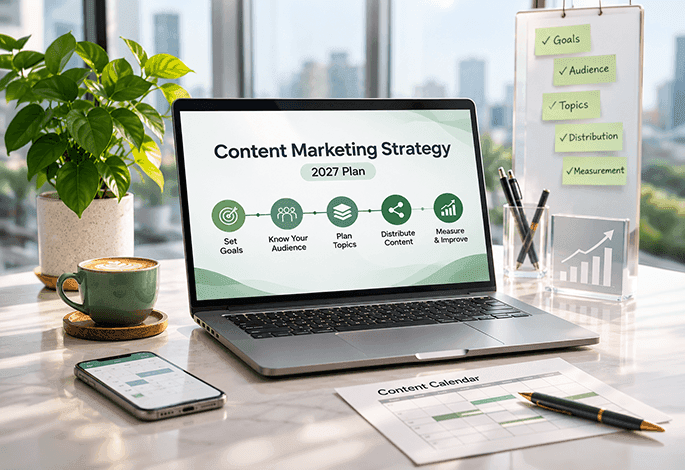
Follow these eleven steps in order and revisit them each year.
Step 1: Define clear goals and KPIs
Start with a business outcome such as qualified leads or online sales, then choose KPIs that track it. Set a baseline, target, and timeframe. Aligning these goals with your overall digital strategy keeps content tied to company priorities.
Step 2: Research your target audience and buyer personas
Talk to customers and your sales team. Note what worries buyers, which questions repeat, and what blocks a decision.
Step 3: Audit your existing content
Mark each asset to keep, update, merge, or remove. Older pages that still rank often need a refresh, not a rewrite. Check page speed and layout too, since a slow or confusing site undermines good content. Website design and development often belongs in this audit.
Step 4: Research keywords, questions, and search intent
Group topics by intent: informational, commercial, or transactional. Check what already ranks so you know the format and depth required. Search engine optimization services can help if you lack in-house capacity.
Step 5: Analyze competitors and find content gaps
Look for topics competitors cover poorly, questions they leave unanswered, and formats they ignore. Choose gaps where your experience gives you an edge.
Step 6: Choose content types and channels
Match formats to audience habits. Pick a few channels you can sustain well instead of spreading thin.
Step 7: Build topic clusters and a content roadmap
Create a pillar page supported by linked articles that answer narrower questions. Sequence clusters by business value and production speed. A clean site structure from website design and development makes these clusters easier for readers and crawlers to navigate.
Step 8: Create a content calendar and workflow
Define who briefs, writes, edits, approves, and publishes. A clear workflow prevents the bottlenecks that sink most plans.
Step 9: Produce high-quality, expert-led content
Open with a direct answer, then add examples and practical detail. Involve subject experts, name authors, and verify every factual claim.
Step 10: Distribute and promote your content
Share through email, partners, sales conversations, and social media marketing. If your audience trusts particular voices, influencer marketing can carry your best content to new readers. Repurpose one strong piece into several formats.
Step 11: Measure results and refine the strategy
Review results against your KPIs on a fixed schedule. Double down on what works and retire what does not.
How to Build Content That Works in Google and AI Search
Traditional results, featured snippets, and AI summaries reward the same fundamentals. Strong SEO and strong content depend on each other.
- Write direct answers: Place a two to three sentence answer under question-based headings, then expand.
- Build topical authority: Cover a subject from several angles and link the pieces together.
- Show E-E-A-T: Name your authors, explain their expertise, and keep information current.
- Use matching structured data: Add schema only where it reflects what is visible on the page. Your website development team can implement it cleanly.
Content Types to Include in Your 2027 Strategy
Choose the formats your audience and capacity can support:
- Blog posts and guides: the backbone of search visibility.
- Video and short-form content: ideal for demonstrations and repurposing.
- Case studies and original research: strong trust builders, if the data is sound.
- Email newsletters: a direct line to your audience.
- Social media content: extends reach when adapted to each platform.
- Lead magnets: checklists, templates, and ebooks that solve one problem quickly.
How to Create a Content Calendar
- List three to five content pillars.
- Set a publishing rhythm you can keep for months.
- Add roadmap topics with a target keyword and funnel stage.
- Assign owners and deadlines for drafting, editing, and approval.
- Plan where and when each piece will be promoted.
- Reserve monthly time to refresh older content.
- Review monthly and adjust.
Content Marketing Strategy for Different Business Types
- B2B and SaaS: long buying cycles call for in-depth guides, comparisons, and case studies.
- Ecommerce: buying guides and category content that reduce uncertainty at purchase, supported by influencer marketing for product discovery.
- Local and service businesses: practical answers to customer questions and real project examples.
- Startups on a limited budget: one audience, one core topic area, and one or two channels. Depth beats volume.
How to Use AI Tools in Content Marketing Responsibly
AI helps with research, outlines, headline options, and repurposing finished pieces. Human expertise matters for original insight, accuracy, and brand voice. To avoid thin content, brief the tool with your data and point of view, add real examples, and fact-check everything. If a competitor could have published your draft, it is not ready.
How to Measure Content Marketing Success
Track organic traffic for visibility, engagement for relevance, and leads, conversions, and revenue influenced for commercial impact. Use Google Analytics for behaviour, Search Console for search performance, and CRM data to connect content to deals. Check results monthly, review the roadmap quarterly, and reassess the full strategy yearly.
Common Content Marketing Strategy Mistakes to Avoid
- No clear goals
- Publishing without research
- Ignoring distribution
- Chasing volume over quality
- Never updating older content
Should You Hire a Content Marketing Agency?
In-house teams work well when you have deep subject expertise and a dedicated editor. A content marketing agency makes sense when you lack capacity, need specialist skills, or want an objective view of what holds results back. Look for a clear process, relevant experience, transparent reporting, and a focus on business outcomes.
How Webmaffia Can Help With Your Content Marketing Strategy
Webmaffia offers content marketing, SEO, and social media services that plan, produce, and distribute content around your business goals. Discuss Your Requirements with our team.
Frequently Asked Questions About Content Marketing Strategy
What are the steps of a content marketing strategy?
Set goals, research your audience, audit existing content, research keywords, analyse competitors, choose formats, build a roadmap and calendar, produce content, distribute it, and measure results.
How do I create a content marketing strategy from scratch?
Start with one goal and one audience. Research their questions, choose topics where you have real expertise, publish consistently, and expand based on results. A digital strategy consultation can help you set priorities.
How much should I budget for content marketing?
There is no single figure. Cost depends on output volume, depth, formats, in-house versus agency work, and distribution spend. Start from your goal and price the output needed.
How long does content marketing take to show results?
Search results typically take several months and longer for competitive topics. Email and social distribution can bring earlier engagement.
What is the difference between content marketing and SEO?
Content marketing creates useful content across channels. SEO makes that content discoverable in search. SEO guides what to create, and content gives SEO something worth ranking.
Conclusion
A strong content marketing strategy rests on clear goals, a well-understood audience, and a repeatable process for creating, distributing, and measuring content. Start with goals and audience, then build your roadmap and calendar, and refine as data comes in. If you want expert help shaping or running your plan, get in touch with Webmaffia to take the next step.
following blog articles.