Is Top Of Funnel Content Still Worth It In 2027?
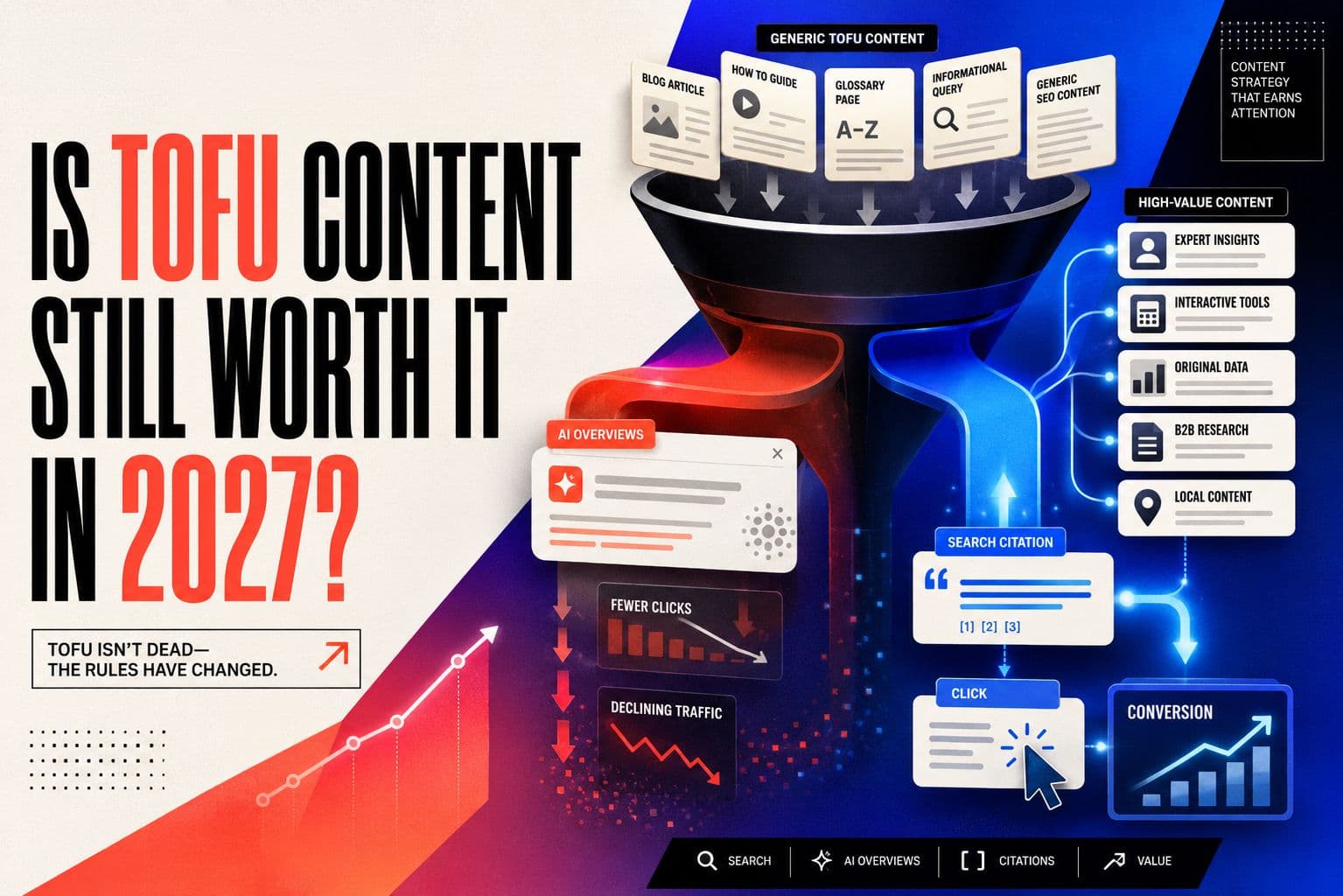
We hear this question in almost every client meeting now. AI Overviews are eating into clicks, everyone's competitor is pumping out AI-written "what is" and "how to" posts by the dozen, and the SERP just feels more crowded than it did two years ago. So naturally, people want to know: is it even worth writing top-of-funnel (TOFU) content anymore?
Short answer - it depends a lot on your industry, and honestly, on how well you execute. Not the answer anyone wants, but it's the accurate one. Here's what's actually happening in the data, and what we think it means going into 2027.
Traffic Isn't Falling the Same Way Everywhere
Look at major publishers over the last year and you'll see a pretty clean split. Finance, healthcare, legal, and consumer tech sites - the glossary pages, the "how to" articles, the generic guides - have all bled traffic. That's not random. Those are exactly the categories Google treats as Your Money or Your Life (YMYL), and that's where AI Overviews show up most aggressively, answering the question before anyone clicks through.
Meanwhile, B2B software, cybersecurity, and cloud infrastructure brands actually gained TOFU traffic in the same window. And here's the part we found genuinely interesting: when you compare this to middle-of-funnel content - the comparison pages, the "X vs Y" posts - the same pattern shows up. Whatever's happening to TOFU in a given industry, MOFU is doing the same thing right alongside it. The funnel stage barely matters. Industry does.
Which tells you something practical: if you're in B2B tech, fintech-adjacent SaaS, or cybersecurity, TOFU content is still earning its keep. If you're in a YMYL space, moving budget from TOFU to MOFU isn't going to save you - the AI Overview problem doesn't care which stage of the funnel your page sits at.
Why B2B Holds Up Better
It really just comes down to how much research a buyer needs before deciding anything. Someone searching a symptom or a tax rate is usually happy with a quick, confident AI summary - done, question answered, no click needed. Someone evaluating a security vendor, or planning a platform migration, is not in that position. That's a slower, higher-stakes decision, and no single AI Overview is going to satisfy it.
There's also a timing edge working in B2B's favor. Software and infrastructure topics move fast - fast enough that an LLM's training data can be out of date within months. When the model isn't confident it has the answer, it's far more likely to go search live and cite whoever does have it. Which, if that's your page, is still a click.
What Actually Works for TOFU Right Now
A few things keep coming up as genuinely effective, no matter the industry.
Local content built around real local needs, for one. LLMs are still bad at location awareness, and AI Overviews just don't show up as often for local queries. But it's not enough anymore to swap the city name into a template - what's actually working is content written with a real understanding of what that specific service area needs.
Interactive tools also stand out. Plain how-to content barely gets cited by LLMs - makes sense, since the models are already pretty good at writing generic how-to answers themselves, so why would they send someone to yours? Calculators, screeners, and similar ungated tools are a completely different story. AI systems can point to a tool and recommend it by name, but they can't actually replicate what it does. That makes tools one of the few TOFU formats AI search amplifies instead of quietly replacing.
And then there's the human factor - real subject-matter expertise. AI summaries are, by nature, careful and even-handed. They don't take strong positions, they don't share an opinion earned from actually doing the work, and they definitely don't connect a concept to how messy it looks in practice. A "what is X" piece written by someone who's actually run the process - who's made the mistakes, formed real opinions about the tradeoffs - just reads differently. It's also more likely to contain the kind of original insight that gets a page cited by AI in the first place, rather than skipped over.
The Trouble With Fully Automated Content
Worth saying plainly: a lot of brands have turned to fully automated, AI-scaled content as a TOFU shortcut, and it's easy to see why. Generic informational writing is exactly where AI models are strongest. It's a low-effort bet with decent odds of some traffic.
But three things are converging against that strategy right now:
- Quality gains have slowed. Model-to-model improvement in long-form writing isn't accelerating the way it was, and fully automated pieces still need real human editing and per-article prompting to hold up at all.
- AI detection is becoming normal infrastructure - watermarking, detection tools baked into the platforms people already use - and readers are also just getting better at spotting AI writing on their own.
- Google itself seems to be tightening up. Recent spam updates increasingly target scaled content specifically, on top of the usual engagement and backlink signals it's always tracked.
None of this means AI has no place here. AI-assisted human writing still performs well, sometimes very well. The line isn't "AI vs. no AI" - it's whether a skilled writer is using AI as a tool, or whether AI has quietly replaced the writer altogether.
So, Should You Still Be Writing TOFU?
If you're B2B or in a technically complex industry - yes. It's still one of the more dependable pieces of a content strategy. If you're in a YMYL space, the answer isn't to abandon TOFU, it's to reset your expectations for it. Local specificity, real tools, and genuine expertise still create value even where AI Overviews dominate the SERP.
The bigger shift here isn't that TOFU stopped working - it's that the competition changed. Every page you publish now has to beat not just other brands, but the AI Overview and the LLM answer sitting above it. Which is really why the only question worth asking before you hit publish isn't "will this rank" - it's the more basic one: does this page actually deserve to exist?
If you're trying to figure out where TOFU still fits in your funnel, or want a content strategy built around what's actually earning AI citations right now, Webmaffia's SEO and content team can help you map out what's working for your specific industry.
following blog articles.