Shopify vs Custom Build: Which Is Right for Your Business?
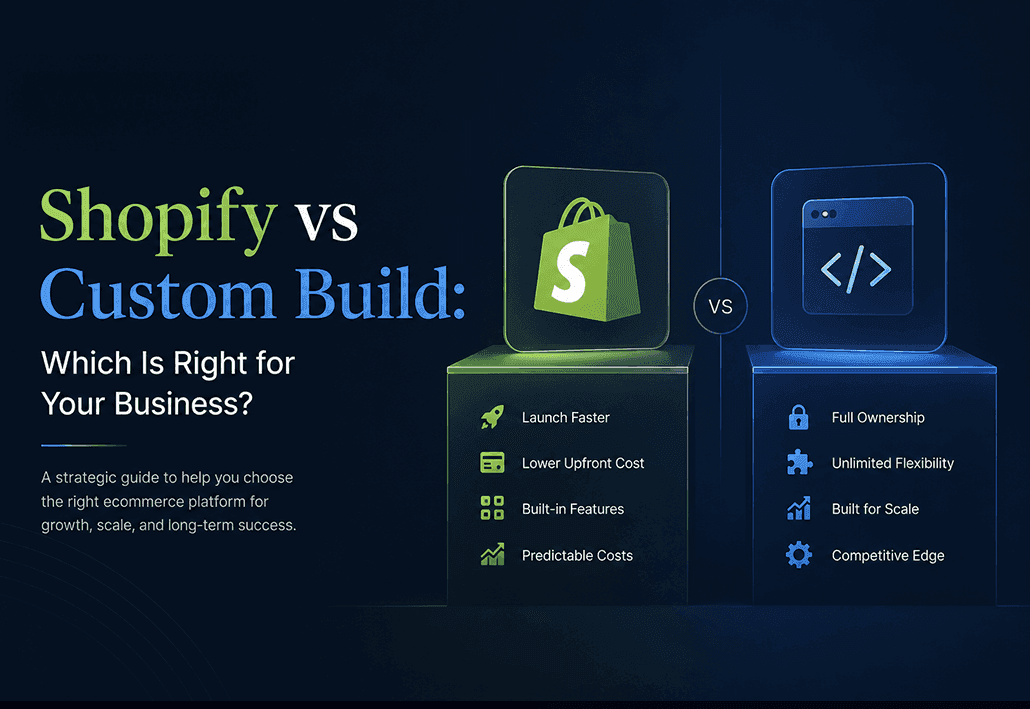
Choosing between Shopify and a custom-built ecommerce website is one of the most consequential decisions you will make as a business owner. Get it right, and your platform becomes a growth engine. Get it wrong, and you spend years fighting technical limitations or burning budget on rebuilds.
This is not a feature comparison. This is a decision-making guide built on real business considerations.
What Is Shopify?
Shopify is a hosted ecommerce platform that lets businesses launch online stores without writing code. It handles hosting, security, payment processing, and software updates. You choose a theme, configure your settings, and start selling.
Shopify powers over 4.6 million live websites globally. For good reason. It removes the technical barrier to entry and lets teams focus on products, marketing, and customer experience rather than server management.
Shopify works best when you need to launch quickly, have a lean or non-technical team, your product catalog and business workflows are relatively straightforward, or you want predictable monthly infrastructure costs.
What Is Custom Ecommerce Development?
Custom ecommerce development means building a store from the ground up, or significantly extending an open-source platform like WooCommerce or Magento, to meet your exact specifications. Every feature, every user flow, every integration is built intentionally.
Custom builds are not just for enterprise companies. They are for any business whose growth is being constrained by what a platform will and will not allow.
Custom development makes sense when your business has unique operational workflows, you need integrations that do not exist as off-the-shelf plugins, brand experience and front-end performance are non-negotiable, or you are building for scale and long-term competitive differentiation.
The Core Differences That Actually Matter
Most comparisons get lost in surface-level feature lists. What actually affects your business outcomes comes down to a handful of critical distinctions.
Ownership and Control
With Shopify, you are renting your store. You do not own the platform, the infrastructure, or the codebase. If Shopify changes its pricing, deprecates a feature, or restricts a functionality, you adapt or migrate.
With a custom build, you own everything. The code, the architecture, the data structure. That ownership gives you complete control over your store's future. This distinction matters more as your business grows. At $500K in annual revenue, Shopify's constraints are manageable. At $5M, they start costing you real money and opportunity.
Development Speed and Time to Market
Shopify wins decisively on launch speed. A functional, well-designed Shopify store can go live in weeks. A custom build typically takes three to six months, depending on complexity. If you are validating a new product line, entering a new market, or operating with a tight launch window, Shopify's speed advantage is significant and real.
Cost Structure
Shopify has predictable monthly costs but they compound over time. Factor in monthly plan fees (Basic to Advanced to Plus), transaction fees if you do not use Shopify Payments, app subscriptions which add up faster than most businesses expect, and theme licensing costs.
Custom development has a higher upfront investment, typically ranging from tens of thousands to hundreds of thousands depending on scope. However, you eliminate monthly platform fees and recurring app costs. Over a three-to-five year horizon, the total cost of ownership often favours a well-built custom solution for high-revenue businesses.
Scalability
Shopify scales well for most mid-market businesses. Shopify Plus handles high-volume merchants and provides more flexibility around checkout customisation, scripts, and automation. But there is a ceiling. Shopify's architecture is designed for the majority of merchants, not for edge cases. If your business model is non-standard — complex pricing tiers, subscription models, B2B workflows, or deeply customised checkout logic — you will hit those limits.
Custom builds scale on your terms. The architecture is designed around your specific load requirements, database structure, and business logic.
SEO Capabilities
Shopify has solid SEO fundamentals. It generates sitemaps automatically, supports meta fields, and handles canonical URLs. For most businesses, this is sufficient. However, Shopify has structural limitations that matter for SEO. URL structures are fixed. The platform adds unnecessary URL paths that cannot be removed. Page speed is influenced by third-party app bloat. Faceted navigation and crawl budget management require workarounds.
Custom builds give you complete SEO architecture control. You define your URL structure, control your rendering approach (server-side, static, or hybrid), manage crawl budget precisely, and implement structured data exactly as needed. For businesses targeting competitive keywords with high-intent traffic, this level of control is a genuine ranking advantage.
When Shopify Is the Right Choice
Do not overcomplicate this decision. Shopify is the right call in many situations. Choose Shopify if you are launching a new brand and need to move fast, your annual revenue is under $2M and growing steadily, you sell physical products with a standard catalog structure, your team has limited technical resources, you want to focus budget on marketing not infrastructure, or you are testing a new market or product concept before committing to full development.
A D2C skincare brand launching with 20 SKUs, a strong marketing strategy, and a six-month runway to prove product-market fit has no business spending on custom development upfront. Shopify lets them allocate resources where they generate returns.
When a Custom Build Is the Right Choice
Some businesses outgrow Shopify quickly. Others have requirements that Shopify was never designed to meet. Choose custom development if your business has unique pricing logic, complex product configurations, or non-standard workflows, you are building a B2B ecommerce platform with account-specific pricing, approval workflows, or ERP integration, you need front-end performance and brand experience that Shopify themes cannot deliver, you are scaling toward eight figures, you require deep integration with custom inventory systems, or competitive SEO and organic traffic are central to your growth strategy.
An industrial equipment manufacturer selling through complex quote-to-order workflows, or a multi-brand retailer managing separate catalog logic for different buyer segments, needs custom architecture. Shopify is not built for that use case.
Common Mistakes Businesses Make
Choosing Shopify because it is cheaper upfront. The upfront cost comparison is misleading. Calculate total cost of ownership over three years, including apps, transaction fees, platform migration risks, and developer costs to work around platform limitations.
Building custom too early. Many early-stage founders invest in custom development before validating their market. Build on Shopify first. Validate your business model. Then invest in custom infrastructure when you have the revenue and data to justify it.
Underestimating migration costs. Businesses that outgrow Shopify and need to migrate face significant complexity. Data migration, URL redirects, SEO preservation, and custom development all have real costs. Factor this into your long-term planning from day one.
Treating the platform decision as permanent. Your platform choice should match your current stage, not your five-year ambition. Start where you are. Build the infrastructure your revenue justifies.
Questions to Ask Before You Decide
Before committing to either path, work through these questions honestly: What is our realistic revenue projection for the next 24 months? Do we have any workflows, integrations, or product configurations that fall outside standard ecommerce models? How important is SEO and organic traffic to our growth strategy? What is our internal technical capacity? Are we optimising for speed to market or for long-term platform ownership? What would it cost us to migrate platforms two years from now if we outgrow our initial choice?
Your answers will clarify the decision more than any feature comparison will.
Maintenance, Security, and Long-Term Ownership
Shopify handles hosting, security patches, and platform updates automatically. For small teams, this is a significant operational advantage. Custom builds require ongoing maintenance. That means a technical team or a trusted development partner responsible for security updates, performance monitoring, and infrastructure management. This is a real cost and commitment that businesses often underestimate.
However, with a custom build, your security posture is entirely within your control. You are not dependent on a SaaS vendor's security decisions or affected by platform-wide vulnerabilities.
Marketing and Integration Capabilities
Shopify's app ecosystem is extensive. Email marketing, loyalty programs, review platforms, analytics tools, and advertising integrations are available as plugins. For most marketing stacks, Shopify integrates adequately. Custom builds offer deeper integration possibilities. If your marketing operations rely on proprietary data structures, complex personalisation logic, or real-time inventory-driven campaign management, custom architecture provides the flexibility that platforms cannot.
The Decision Framework
Stage 1 — Early and Validating (Revenue under $500K). Start with Shopify. Speed and cost-efficiency matter most. Focus on product-market fit and marketing execution.
Stage 2 — Growing and Optimising (Revenue $500K to $3M). Evaluate Shopify's limitations against your specific bottlenecks. If the platform is constraining conversion, SEO, or operational efficiency, begin planning a custom build or hybrid approach.
Stage 3 — Scaling and Differentiating (Revenue $3M and above). Seriously evaluate custom development. At this scale, platform fees are material, competitive differentiation matters, and operational efficiency gains from custom workflows generate real ROI.
Stage 4 — Enterprise and Complex Operations. Custom is almost always the right answer. Enterprise-grade performance, security, compliance, and integration requirements exceed what hosted platforms reliably deliver.
FAQ
Is Shopify good for SEO?
Shopify provides solid SEO fundamentals including automatic sitemap generation, customisable meta fields, and SSL. However, it has structural limitations including fixed URL patterns and potential page speed issues from app bloat. For businesses where organic search is a primary growth channel and competitive keywords are the target, custom development offers greater SEO architecture control.
How much does a custom ecommerce website cost?
Custom ecommerce development typically ranges from $20,000 to $200,000 or more depending on scope, complexity, and the development team. Enterprise-grade builds can exceed this significantly. However, total cost of ownership over three to five years often makes custom development cost-competitive with Shopify for high-revenue businesses when platform fees, transaction costs, and app subscriptions are included.
Can Shopify handle enterprise-level ecommerce?
Shopify Plus is designed for high-volume merchants and handles significant transaction volumes. However, businesses with complex B2B workflows, highly customised checkout requirements, unique pricing logic, or deep ERP integrations frequently find Shopify Plus insufficient and migrate to custom solutions.
What is the main advantage of Shopify over a custom website?
Speed to market is Shopify's clearest advantage. A fully functional store can launch in weeks without significant technical resources. For early-stage businesses validating a market or product, this speed advantage is substantial and directly reduces risk.
How long does custom ecommerce development take?
A custom ecommerce build typically takes three to six months for mid-market scope. Complex enterprise projects can take six to twelve months or longer. Timeline depends heavily on the number of custom integrations, the complexity of the product catalog, and the thoroughness of the discovery and planning phase.
Should I migrate from Shopify to a custom platform?
Migration should be considered when Shopify's limitations are measurably impacting revenue, operational efficiency, or SEO performance. Common triggers include hitting checkout customisation limits, high recurring app and platform costs, inability to implement required integrations, and performance bottlenecks. Always conduct a thorough cost-benefit analysis before migrating.
Which platform is better for D2C brands?
Early-stage D2C brands almost always benefit from starting on Shopify. The speed, ecosystem, and cost structure suit the validation phase. As D2C brands scale and begin competing on organic traffic, brand experience, and operational efficiency, custom development becomes increasingly justified.
Make the Decision Based on Your Business, Not the Trend
Conclusion: The honest answer is that neither Shopify nor custom development is universally superior. The right choice depends entirely on your stage, your growth model, your operational requirements, and your long-term ambitions.
Shopify is an excellent platform for businesses that need to move fast, operate lean, and focus resources on marketing and product. It has earned its market position for good reason. Custom development is the right investment for businesses that have outgrown platform constraints, need unique functionality, or are building for long-term competitive differentiation at scale.
The mistake most businesses make is choosing based on what they aspire to be rather than what they actually are today. Start with the platform that serves your current reality. Build toward the infrastructure your future revenue will justify.
following blog articles.