Signs Your Website Is Outdated and Hurting Your Brand
Your website is often the first thing a potential customer sees. Before they read a single word of your copy, before they look at your pricing, before they decide whether to trust you, they have already formed an impression. And if your website looks or feels outdated, that impression works against you.
The problem is that most businesses don't realize their website has become a liability. The site was built, it launched, it worked reasonably well, and then life moved on. The business grew. The market shifted. Design standards evolved. But the website stayed the same.
What felt modern three years ago now signals neglect. What ranked on page one two years ago is now buried. What converted visitors in a different era of user expectations now drives them away.
This article is a practical diagnostic. If you recognize your website in several of these signs, the cost of inaction is likely higher than you think.
Why an Outdated Website Is a Business Problem, Not Just a Design Problem
It is tempting to think of a website redesign as a cosmetic exercise. A fresh coat of paint. New fonts. Updated photos. In reality, an outdated website creates compounding damage across multiple areas of your business simultaneously.
It undermines trust before you have had a chance to build it. It hurts your search rankings because Google explicitly factors in user experience signals like bounce rate, page speed, and mobile usability. It costs you conversions because users who encounter friction or doubt simply leave and choose a competitor. And it damages brand perception in ways that are difficult to measure but very real.
Website credibility issues are not abstract. They translate directly into lost revenue, reduced organic visibility, and a weakening competitive position. The longer an outdated website remains in place, the more ground a business concedes.
The Most Telling Signs of an Outdated Website
Your Website Is Not Mobile-Responsive
If your website does not adapt cleanly to smartphones and tablets, it is not just outdated. It is actively failing the majority of your visitors.
Mobile traffic accounts for more than half of global web usage. Users who land on a website that forces them to pinch, zoom, or scroll horizontally leave almost immediately. More importantly, Google uses mobile-first indexing, which means it evaluates and ranks your website based on its mobile version, not the desktop version.
A website that is not fully responsive in 2026 is not competitive. It is a barrier.
Your Page Load Speed Is Slow
Slow websites lose visitors and rankings simultaneously. Google has made page speed a confirmed ranking factor. Users have made it a personal standard. Research consistently shows that the majority of users expect a website to load within two to three seconds and will abandon it if it doesn't.
Outdated website design almost always carries technical debt that slows performance. Uncompressed images, legacy code, outdated plugins, bloated themes, and the absence of modern caching or content delivery networks all contribute to sluggish load times.
If you haven't run your site through Google PageSpeed Insights or a similar tool recently, do it now. The score will tell you a great deal about how both users and search engines are experiencing your website.
Your Design Looks Like It Belongs to a Previous Decade
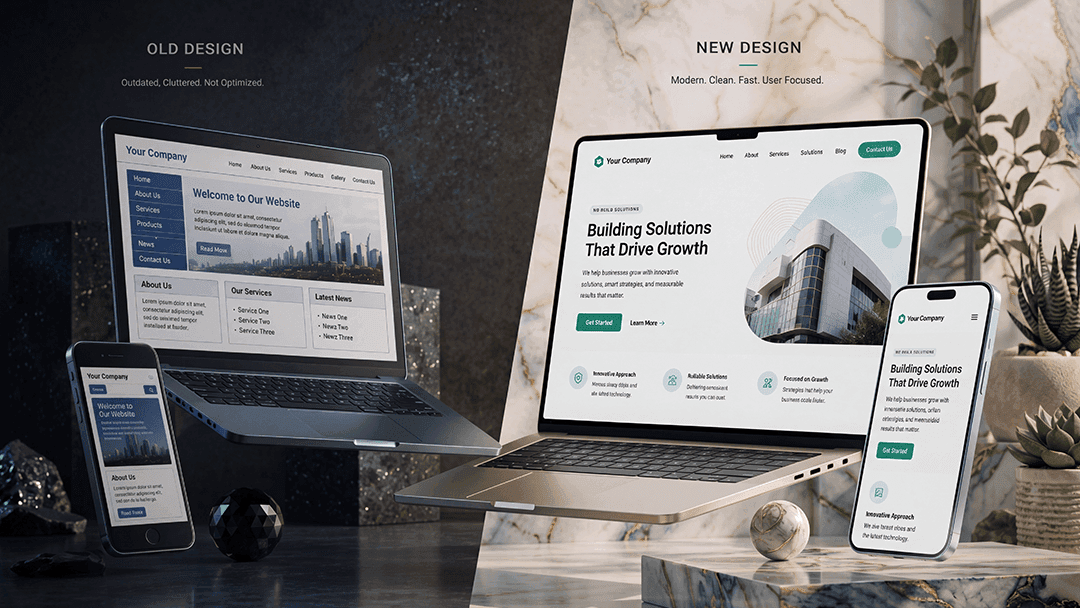
Design trends evolve for a reason. They reflect changes in user expectations, screen technology, and what communicates credibility in a given era.
Some clear visual indicators of an outdated website include:
• Heavy use of skeuomorphic design elements such as embossed buttons, gradients, and drop shadows that were standard in the early 2010s
• Flash-based animations or introductions, which no longer function in modern browsers
• Cluttered layouts with content packed into every available space
• Tiny typography that assumes users are on desktop monitors
• Stock photography that looks generic, staged, or many years old
• Misaligned elements and inconsistent spacing across pages
• Color schemes and font combinations that no longer align with your brand positioning
None of this is about chasing trends for their own sake. It is about the fact that users make credibility judgments based on visual design, and a site that looks old communicates that the business behind it is either not investing in itself or is behind the curve.
Your Website Has No SSL Certificate
If your website still shows as "Not Secure" in the browser address bar, visitors are seeing a warning before they see your content. This is a significant trust barrier.
SSL certificates encrypt the connection between a user's browser and your server. They have been a basic web standard for years. Google flags sites without them. Modern browsers warn users before they even enter. And any ecommerce site or website that collects personal information without SSL is creating both a credibility problem and a legal exposure.
If your site is still running on HTTP rather than HTTPS, this needs to be resolved immediately regardless of any other redesign considerations.
Your SEO Performance Has Declined Without Explanation
If your organic traffic has dropped, your keyword rankings have slipped, or pages that used to perform well are now invisible, your website's technical and structural state is likely a contributing factor.
Outdated website SEO impact is real and cumulative. Search engines have significantly evolved their evaluation criteria over the past several years. Core Web Vitals now directly affect rankings. Structured data, semantic HTML, and mobile usability all factor into how Google assesses and ranks pages.
An outdated website built before these standards became priorities will underperform against competitors whose sites are built to meet current expectations. And each algorithm update that rewards modern technical standards widens that gap further.
Signs that your website may have an SEO structural problem include:
• No meta descriptions or title tags on key pages
• Missing or broken internal linking structure
• Images without alt text
• Pages that load too slowly to pass Core Web Vitals thresholds
• No structured data markup
• Content that has not been updated in years
• A URL structure that is inconsistent or poorly organized
Your Bounce Rate Is Consistently High
Bounce rate measures the percentage of visitors who land on your website and leave without taking any action or visiting another page. A consistently high bounce rate is a signal that something about the experience is failing.
It could be designed. It could be load speed. It could be a mismatch between what users expected and what they found. It could be that the site works poorly on mobile. Often it is a combination.
Whatever the specific cause, a high bounce rate tells you that visitors are arriving and immediately deciding this website is not for them. That is a conversion problem, a trust problem, and an SEO problem all at once, because Google factors engagement signals into its assessment of content quality.
Your Content Has Not Been Updated in Years
Stale content is a visible sign of an outdated website, and it damages credibility in multiple ways.
Blog posts with dates from several years ago suggest the business is no longer active or engaged. Product descriptions that reference old specifications or discontinued features create confusion. Service pages that no longer reflect what you actually offer mislead potential customers. Case studies and testimonials with no recent additions make your portfolio look frozen in time.
Fresh, relevant, accurate content is both an SEO requirement and a trust signal. Users want to know they are engaging with a business that is current, active, and invested in its own presence.
Your Website Does Not Reflect Your Current Brand
Businesses evolve. Positioning shifts. Target audiences change. Product lines expand or contract. Leadership changes. Brand identity gets refined.
But websites, unless actively maintained, tend to preserve an older version of what the business was rather than what it has become.
If a prospective customer visits your website and finds messaging, imagery, or a visual identity that no longer matches how you present yourself elsewhere, the disconnect creates confusion and erodes trust. Consistency across all brand touchpoints is foundational to credibility, and the website is usually the most visited of them all.
Your Navigation Is Confusing or Outdated
Navigation is the architecture of a website's user experience. When it is unclear, users cannot find what they are looking for. When it is bloated, users become overwhelmed. When it no longer reflects the actual structure of the business or its offerings, it misdirects visitors.
Common navigation problems on outdated websites include:
• Too many top-level menu items competing for attention
• Dropdown menus that don't function properly on mobile
• Broken links leading to pages that no longer exist
• Pages buried so deep in the structure that they are effectively invisible
• No clear pathway guiding users toward the primary conversion action
If users cannot get where they need to go quickly and easily, they won't stay long enough to convert.
Your Competitors' Websites Look Significantly Better
This is a practical business reality. Users visit multiple websites when researching a purchase or evaluating a service provider. They compare. And their comparison is heavily influenced by design and user experience.
If your competitors have invested in modern, well-structured, fast-loading websites and yours has not kept pace, the contrast works against you. Users associate the quality of a website with the quality of the business behind it. A competitor with a better digital presence has a trust advantage before a single sales conversation has taken place.
Conducting a periodic competitive audit of how your website compares to others in your space is not vanity. It is market awareness.
Your Conversion Rate Has Dropped or Plateaued
If your traffic is stable or growing but your conversion rate is declining or flat, the website itself is likely creating friction in the user journey.
Conversion is the end result of every design, content, and trust decision on your website. When those decisions are outdated, the conversion rate reflects it. Unclear calls to action, forms that are too long or poorly designed, product pages that lack sufficient information, checkout flows that create unnecessary steps, these are all design and content problems that compound over time.
A conversion rate audit, looking at where users drop off and what the most common exit pages are, will often reveal exactly where the website is failing.
Your Website Was Built on an Outdated or Unsupported Platform
If your website was built on a content management system or ecommerce platform that is no longer actively maintained, or on a version of a platform that is significantly out of date, you are carrying technical risk that affects security, performance, and functionality.
Outdated platforms are more vulnerable to exploits. They are less compatible with modern integrations, third-party tools, and browser standards. They are often slower and harder to maintain. And in some cases, they simply cannot be updated to meet current requirements without a full rebuild.
This is one of the most pragmatic cases for a redesign. The underlying technical foundation of your website determines what is possible for your business online, and an outdated foundation limits everything built on top of it.
How to Know If Your Website Needs a Redesign: A Quick Self-Assessment
If you are asking yourself how to know if your website is outdated, run through these questions honestly:
1. Does your website load in under three seconds on mobile?
2. Does it display correctly on all screen sizes without horizontal scrolling?
3. Is it running on HTTPS with a valid SSL certificate?
4. Does the design reflect where your brand is today, not where it was three or five years ago?
5. Has your organic traffic grown or at least held steady over the past 12 months?
6. Is your bounce rate within an acceptable range for your industry?
7. Does your website convert visitors at a rate that reflects your actual product or service quality?
8. Is your content current, accurate, and genuinely useful to your target audience?
9. Is your navigation clear and your user journey logical?
10. Does your website compare favorably to the leading competitors in your space?
If you answered no to three or more of these, the conversation about a redesign or significant refresh is worth having now rather than later.
The Cost of Waiting
Every month that an outdated website remains in place is a month of lost opportunity. Traffic that should be converting is bouncing. Rankings that should be improving are stagnating or declining. Brand impressions that should build trust are instead creating doubt.
The businesses that treat their website as a living asset, something that requires ongoing investment and periodic strategic renewal, consistently outperform those that treat it as a fixed cost with a one-time setup.
Signs your website needs a redesign are not always dramatic. Sometimes they accumulate gradually, like a slow leak. The damage is real before it becomes obvious. Acting before the situation becomes critical is almost always less expensive and less disruptive than waiting until it is unavoidable.
FAQ: Outdated Website Signs and Redesign Decisions
What are the most common signs of an outdated website?
The most common signs include a design that looks visually dated, lack of mobile responsiveness, slow page load speeds, declining organic traffic, no SSL certificate, stale content, high bounce rates, and a conversion rate that has dropped without a clear reason.
How do I know if my website is outdated?
Run it through Google PageSpeed Insights for technical performance, check it on multiple mobile devices, review your Google Analytics for traffic and bounce rate trends, compare it visually and functionally to leading competitors, and assess whether the content and messaging still accurately reflect your business.
How does an outdated website affect SEO?
An outdated website typically underperforms in search rankings because it often fails to meet current technical standards including Core Web Vitals, mobile-first indexing requirements, and structured data expectations. Poor user experience signals like high bounce rates and low dwell time also negatively influence rankings.
How often should a website be redesigned?
There is no universal rule, but most websites benefit from a meaningful refresh every two to three years and a more comprehensive redesign every four to five years. The trigger should be performance data and market context rather than a fixed schedule.
What is the difference between a website refresh and a full redesign?
A refresh updates visual elements, content, and minor structural changes without rebuilding the underlying architecture. A full redesign typically involves rebuilding from a new technical foundation, restructuring the information architecture, and redefining the brand presentation and user journey entirely.
Can an outdated website hurt sales?
Yes, directly and measurably. Outdated websites create trust barriers, slow user journeys, and poor conversion experiences. Each of these factors reduces the likelihood that a visitor becomes a customer, regardless of how strong the product or offer actually is.
Conclusion: Your Website Is Either Working For You or Against You
There is no neutral ground. A website that is not actively contributing to business growth is passively working against it. Every outdated design element, every slow-loading page, every piece of stale content, and every friction point in the user journey is costing you something, whether that is traffic, trust, leads, or revenue.
Recognizing the signs early gives you the opportunity to act strategically rather than reactively. The businesses that treat their website as a core business asset, and invest in keeping it current, technically sound, and conversion-optimized, consistently outperform those that don't.
If you have recognized your website in several of the signs covered in this article, the next step is a structured evaluation of what needs to change and why. That evaluation should be grounded in performance data, competitive context, and a clear understanding of your business goals.
Webmaffia works with businesses at exactly that inflection point. Whether you need a full website redesign, a technical and SEO audit, a sharper content strategy, or a broader digital growth plan, the work starts with understanding where your current digital presence is leaving opportunity on the table.
Talk to Webmaffia about where your website stands and what it could be doing better.
following blog articles.