The true cost of delaying your website redesign: it's more than you think
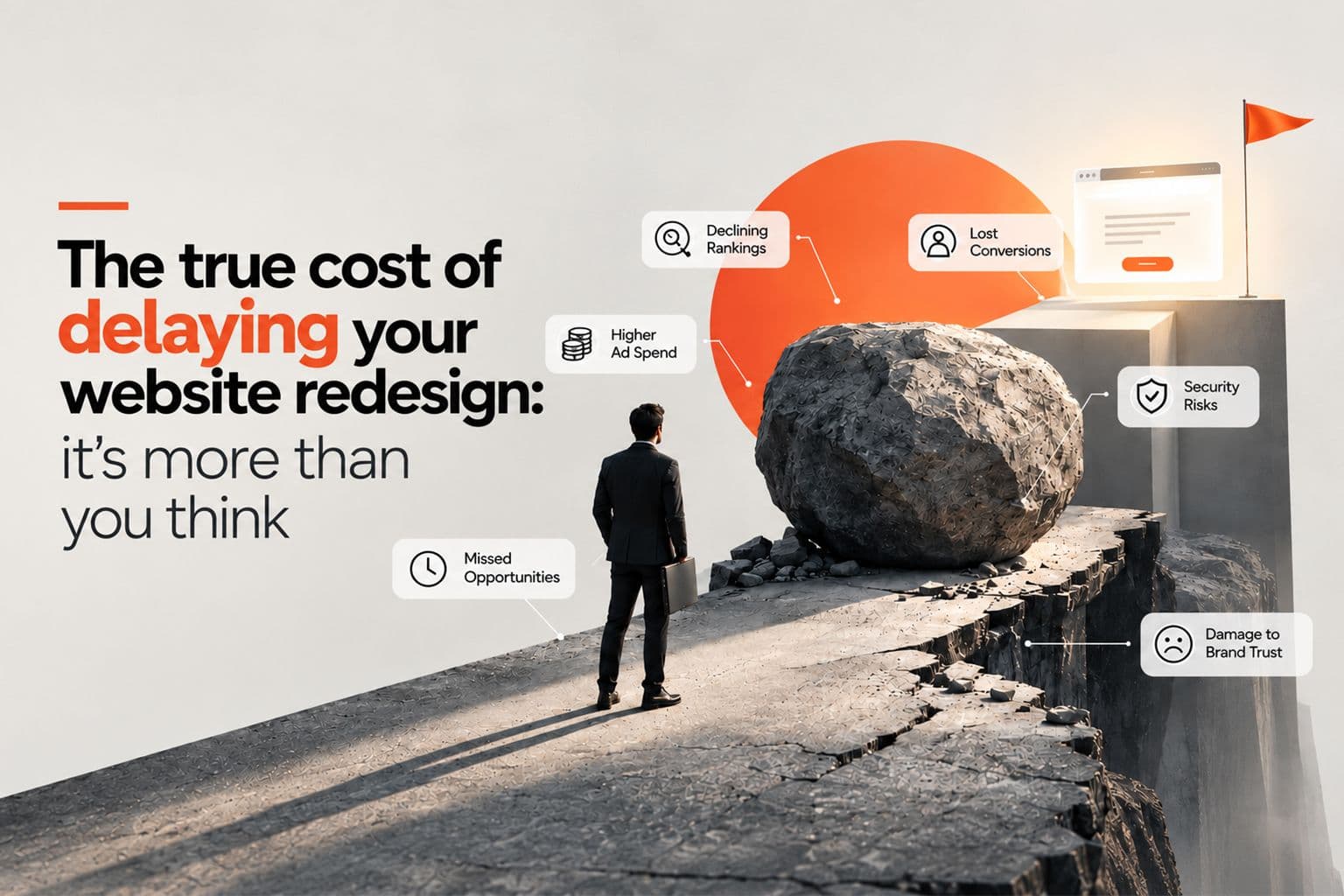
Most businesses don't decide to skip a website redesign. They just keep postponing it. A busy quarter turns into a busy year, the "we'll get to it eventually" list grows, and the website quietly keeps doing its job, just a little worse every month.
That's what makes the cost of delaying website redesign so easy to miss. There's no single moment where the damage becomes obvious. Instead, it shows up gradually: a dip in conversions here, a drop in rankings there, a prospect who bounces off your site and books a call with a competitor instead.
This guide breaks down exactly what delay costs you, the warning signs that your site has already crossed the line from "dated" to "damaging," and how to time a redesign so you're neither too early nor dangerously late.
What "delaying a redesign" actually means
Delaying a redesign isn't just about how old your website looks. A site can be visually dated but still convert well, and a site can look modern while quietly bleeding leads.
In practice, delay means your website has stopped keeping pace with three things at once: user expectations, search engine standards, and your own business goals. Each of these moves independently, which is why redesign decisions often get pushed back. Nothing looks urgent until you compare your numbers against where they used to be, or against what a competitor is doing.
The real risk isn't an outdated website. It's an outdated website that nobody is actively measuring against.
7 hidden costs of putting off your website redesign
1. Lost leads and conversions from an outdated UX
Every extra click, confusing menu, or unclear call-to-action gives a visitor a reason to leave. On an aging site, these friction points accumulate. Visitors don't complain, they just leave, which means the cost is invisible unless you're actively tracking conversion rate over time.
2. Declining SEO rankings and organic traffic
Search engines increasingly reward sites that load fast, structure content clearly, and deliver a smooth mobile experience. An outdated site tends to underperform on all three, which puts pressure on rankings even if the content itself is still relevant. Once a competitor's newer, faster site starts outranking yours, recovering that position typically takes longer than it took to lose it.
3. Higher ad spend to compensate for poor conversion rates
When a website underperforms, many businesses respond by spending more on paid traffic to hit the same lead targets. This masks the real problem. You end up paying a premium, month after month, to send traffic to a site that converts at a fraction of its potential.
4. Damaged brand credibility and trust
For most buyers, especially in B2B and considered-purchase categories, your website is the first real interaction with your brand. A site that feels slow, cluttered, or inconsistent with your current positioning creates doubt before a conversation even starts.
5. Mobile and Core Web Vitals penalties
A growing share of traffic across almost every industry now comes from mobile devices. If your site wasn't built mobile-first, or hasn't been updated to meet current Core Web Vitals thresholds, it's working against both user experience and search visibility at the same time.
6. Security vulnerabilities and compliance risk
Older platforms, plugins, and custom code accumulate unpatched vulnerabilities over time. Beyond the risk of a breach, non-compliance with data privacy expectations can create legal and reputational exposure that far outweighs the cost of a redesign.
7. Rising cost of technical debt (the longer you wait, the more it costs to fix)
The longer a website runs on an aging codebase, the more custom fixes, workarounds, and patches get layered on top of it. Each layer makes a future redesign more complex, because developers now have to untangle years of accumulated shortcuts before they can even start building something new.
8 signs your website redesign is overdue
Your bounce rate is climbing
A steadily rising bounce rate, especially on landing pages that used to perform well, usually signals a mismatch between visitor expectations and what your site delivers.
Your site isn't mobile-friendly or fails Core Web Vitals
If your site struggles on mobile speed tests or Core Web Vitals reports, this is no longer a minor technical detail. It directly affects both rankings and user experience.
Your design looks dated compared to competitors
If a prospect visits your site right after a competitor's and yours feels noticeably older, that comparison is happening whether you're aware of it or not.
Your CMS or tech stack is no longer supported
Running on a platform that's approaching end-of-life, or one your team no longer trusts to make changes without breaking something, is a strong signal that a rebuild is due.
You're losing rankings to newer competitor sites
If competitors with comparable or even less content are consistently outranking you, site experience and technical SEO are often the differentiator.
Your conversion rate has plateaued or dropped
A site that once converted well but has flattened out or declined, despite similar traffic quality, is telling you something about the experience itself.
Your team dreads making even small content updates
If publishing a blog post or updating a service page requires a developer, or breaks something else on the site, your CMS is costing you more in internal time than most people realize.
Your brand has evolved but your site hasn't
Rebrands, new service lines, or a shift in target audience should be reflected on your website. A site that still speaks to your business from three years ago sends mixed signals to new visitors.
How much does delaying a redesign actually cost?
Estimating lost revenue from conversion rate decay
Start with a simple exercise: take your current monthly qualified traffic and multiply it by your conversion rate. Now estimate what that conversion rate looked like when your site was newer, or benchmark it against a well-optimized competitor in your category. The gap between those two numbers, multiplied by your average deal value, is a reasonable estimate of what delay is costing you every single month.
SEO traffic decay: how much organic visibility you lose over time
Ranking losses tend to compound. A page that slips from the first page to the second doesn't just lose a little traffic, it can lose the majority of its clicks, since most search traffic concentrates on top positions. The longer an outdated site sits in a weakened technical state, the harder and slower it becomes to reclaim that visibility.
Redesign cost now vs. redesign cost in 12–24 months
A planned redesign, scoped clearly and built on current best practices, is almost always more cost-effective than an emergency rebuild triggered by a security issue, a platform shutdown, or a sudden drop in performance. Waiting doesn't avoid the cost of a redesign, it usually just moves that cost later and adds a rush premium on top of it.
The cost of redesigning too early vs. too late (finding the right timing)
Signs you're redesigning prematurely
If your current site is converting well, ranking competitively, and easy for your team to manage, a redesign driven purely by aesthetic preference may not be the best use of budget right now. In this case, targeted improvements often deliver more value than a full rebuild.
Signs you've already waited too long
If you're seeing several of the warning signs above at once, particularly declining rankings combined with a flat or falling conversion rate, you're past the point where incremental fixes will solve the underlying problem. At this stage, a full redesign is the more cost-effective path, not the more expensive one.
How Webmaffia helps businesses time and execute a website redesign right
Knowing when to redesign is as important as how you redesign. At WebMaffia, redesign projects start with a clear-eyed audit of performance, technical health, and conversion data, not just a visual refresh. This is paired with digital strategy work to make sure the new site is built around actual business goals, and website design and development that prioritizes speed, mobile performance, and usability from day one.
Because rankings are often at stake during a rebuild, redesign work is also closely coordinated with SEO, so a new site launches without losing the organic visibility a business has already earned.
Frequently asked questions about website redesign costs and timing
Q1. How do I know if my website needs a redesign?
Look for a combination of signals: rising bounce rates, plateaued conversions, mobile or speed issues, an unsupported CMS, and a design that no longer reflects your brand. One issue alone may not be urgent, but several together usually mean it's time.
Q2. What is the average cost of a website redesign in India?
Costs vary widely based on scope, ranging from a straightforward business website to a complex, custom-built platform with integrations. Pricing typically depends on the number of pages, design complexity, functionality, and content needs, so it's best assessed through a scoped consultation rather than a flat estimate.
Q3. How often should a business redesign its website?
Most businesses benefit from a meaningful redesign every 2 to 3 years, though this depends on how fast your industry, brand, and technology stack are evolving. Smaller updates in between can extend the life of a design significantly.
Q4. Does an outdated website hurt SEO rankings?
Yes. Slow load times, poor mobile experience, and weak technical foundations are all factors search engines weigh when ranking sites, so an aging website often underperforms even when its content is still relevant.
Q5. Is it cheaper to redesign now or wait?
In most cases, a planned redesign costs less than an emergency rebuild forced by a security issue, platform end-of-life, or a steep drop in performance. Delay tends to add cost rather than avoid it.
Q6. Can a website redesign be done without losing SEO rankings?
Yes, when it's planned properly. This involves preserving URL structure where possible, setting up correct redirects, maintaining existing content value, and validating technical SEO before and after launch.
Q7. How long does a full website redesign take?
Timelines depend on scope, but most full redesigns take a few months from discovery through launch, factoring in strategy, design, development, content, and testing.
Final checklist: is it time to redesign your website?
Ask yourself honestly:
- Is your bounce rate higher than it was a year ago?
- Does your site struggle on mobile or fail Core Web Vitals checks?
- Has your conversion rate plateaued or dropped?
- Is your CMS outdated, unsupported, or difficult for your team to manage?
- Are competitors outranking or out-designing you?
- Has your brand evolved in ways your website hasn't caught up to?
If you answered yes to three or more of these, the cost of delaying website redesign is very likely already higher than the cost of fixing it. The next step isn't necessarily a full rebuild tomorrow, but it is an honest audit of where your site currently stands. Get in touch with WebMaffia to talk through what that audit could look like for your business.
following blog articles.