What If AI Stops Sending You Traffic? How to Future-Proof Your Business
A founder checks Google Search Console and sees something odd. Rankings have held steady for months. Impressions are actually climbing. But clicks keep sliding, month after month. Nothing looks broken, yet fewer people are arriving on the website.
This is one of the clearest signs of how AI search traffic is changing the relationship between visibility and visits. Being found and being visited are no longer the same thing, and that distinction matters more than most SEO reports currently show. This article looks at why that gap is opening, what it actually means for a business, and what a company should do about it before assuming the worst, or ignoring it entirely.
Why Rankings, Impressions, and Clicks Are Coming Apart
Search used to work in a straight line: rank well, appear on the page, get clicked. That line is breaking. Google AI Overviews and similar answer features now sit above traditional results, generating a direct response to a query using several sources at once. Answer engines and conversational tools like ChatGPT, Gemini, and Perplexity go further, skipping the results page altogether.
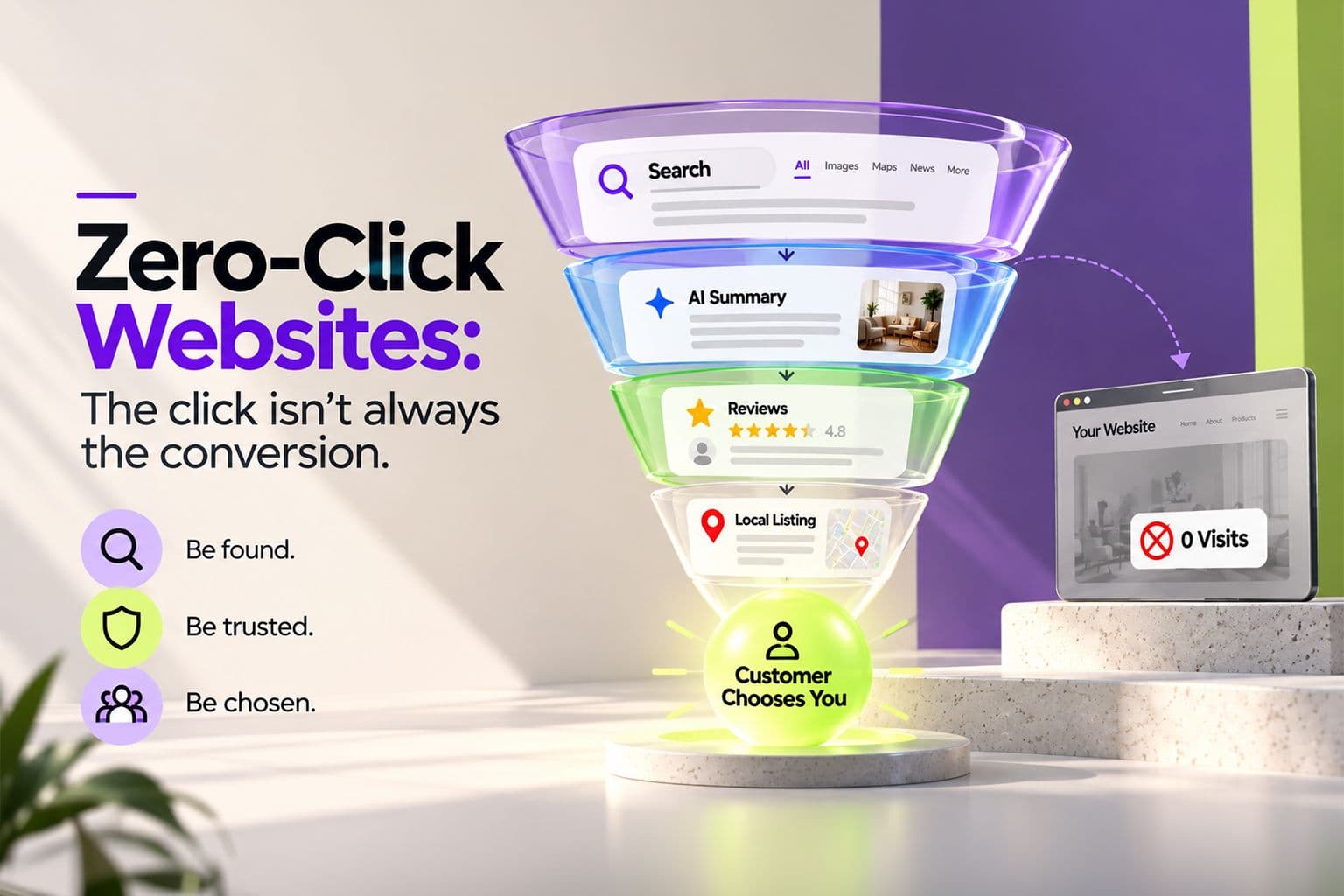
Consider a simple example: someone searches "what is the average cost of a kitchen renovation." A generative AI Overview can summarize price ranges from multiple sources instantly. The searcher gets an answer, feels satisfied, and never clicks through, even if your site was one of the sources used to build that answer. This is what is generally described as zero-click search, and it is why impressions and organic clicks are decoupling in Search Console for many businesses right now. A page can be pulled into an answer, counted as an impression, without ever generating a visit.
This effect is not uniform. Broad informational queries are the most exposed, because an AI summary can fully satisfy the intent. Commercial and transactional queries behave differently. Someone searching "book a plumber near me" or "compare business insurance quotes" still needs to reach a website to act, because AI systems cannot complete a booking, a purchase, or a quote request on the user's behalf. This is the first distinction worth holding onto: a decline in organic search traffic is not one uniform trend, it depends heavily on what the query was trying to accomplish.
What Declining Traffic Actually Means for a Business
Total website traffic, qualified traffic, leads, conversions, and revenue are five different things, and a change in one does not automatically mean the same change in the others. This is the point where many businesses draw the wrong conclusion.
Picture a services company that notices a 15 percent drop in organic sessions over two quarters. On its own, that number looks alarming. But when the marketing team segments the data in Google Analytics 4, most of the lost traffic came from broad, top-of-funnel informational pages, the kind now frequently answered directly inside AI Overviews. Meanwhile, leads from commercial pages, form submissions, and calls stayed flat or improved slightly. The business lost visits that were never likely to convert, while the traffic that actually drives revenue held steady. Traffic fell; business performance did not.
The opposite scenario is also possible. A business could hold its overall traffic numbers while its qualified traffic, the visits from people genuinely close to a buying decision, quietly erodes. That is the pattern worth watching for, and it is why raw session counts alone are an unreliable signal in either direction.
This is also where Google dependency becomes a real business risk, not an abstract one. A company generating most of its leads from one search engine is exposed to any layout change, ranking shift, or expansion of AI-generated answers on that one platform. The goal is not to abandon Google, which still sends valuable, high-intent traffic. The goal is to make sure no single platform holds a business's entire acquisition pipeline hostage.
How AI Search Visibility Works, and Why It Is Not the Same as Ranking
AI search visibility is whether a brand, its expertise, or its content gets surfaced or referenced when someone asks an AI system a relevant question, whether or not that reference produces a click. This is a genuinely different discipline from traditional ranking, sometimes referred to as Answer Engine Optimization (AEO) or Generative Engine Optimization (GEO).
Publicly available information suggests generative systems tend to favor content that answers a question directly, is clearly structured, and comes from sources with consistent, demonstrated authority on the topic. No AI platform publishes an exact method for how it selects or cites sources, so any specific claim beyond that should be treated as informed observation rather than guaranteed mechanics.
What this creates in practice is a new form of brand discovery. If an AI system names your business while answering a category question, even without a click, that mention builds recognition. A potential customer might not visit that day, but weeks later they search your brand name directly, having already encountered it once inside an AI-generated answer. That branded search, and the direct traffic behind it, is a measurable business outcome even though the original AI mention never appears in a traffic report.
Adapting SEO Without Replacing It
AI search optimization does not replace SEO; it extends it. Crawlability, indexability, useful content, and topical authority remain the foundation that both traditional rankings and AI-generated answers draw from. A page that is poorly structured or thin on substance is unlikely to perform well in either environment.
What changes is emphasis. Content that answers a specific question early and clearly, supported by a logical page structure and accurate, consistent information published across the web, is better positioned to be picked up by generative systems. This is less about a technical checklist and more about writing with the same clarity a knowledgeable person would use when actually answering the question, rather than building a page primarily to rank.
A Practical Framework for Future-Proofing Your Traffic Strategy
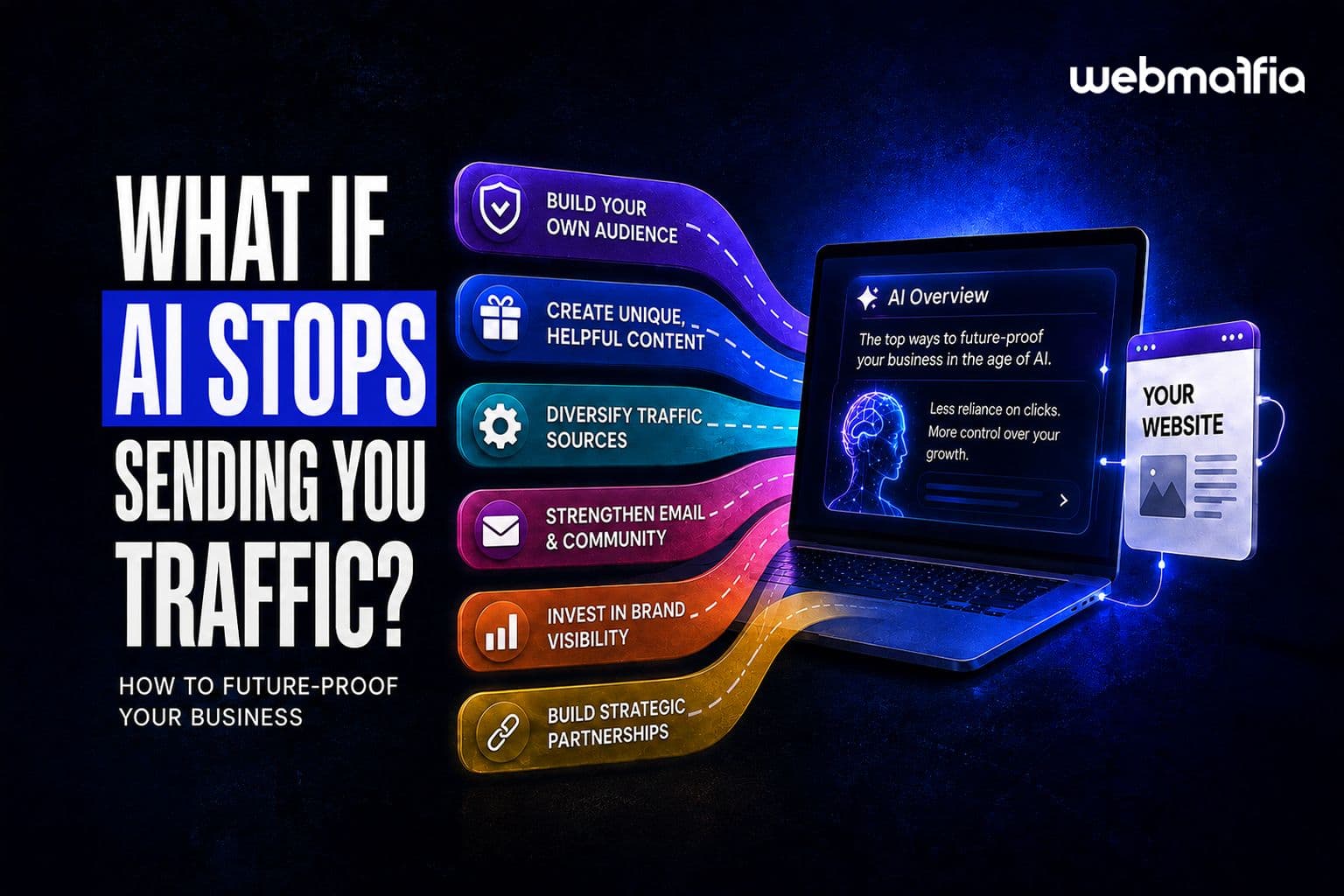
Businesses do not need a completely new strategy. They need a structured way to reduce dependency on any single channel while strengthening the ones that already work. A useful sequence looks like this:
- Assess current dependency. Review what share of leads and revenue comes from organic search alone, and from Google specifically.
- Identify vulnerable queries. Separate informational, top-of-funnel queries, which are more exposed to zero-click answers, from commercial and transactional queries, which still tend to drive visits.
- Strengthen AI search visibility. Build content that answers real questions clearly and maintain consistent, accurate brand information across the web.
- Invest in brand demand. Direct and branded search traffic are largely immune to how any single results page is designed.
- Diversify acquisition channels. Build owned and earned channels, such as email, social media, referral partnerships, and community presence, so demand does not rely on one source.
- Measure qualified outcomes, not just volume. Track leads, conversions, and revenue by source, not session counts alone.
- Revisit the strategy regularly. Search behavior is still evolving, and a channel mix that works today should be reassessed, not assumed permanent.
Not every business needs every channel in that mix. A local service business may lean more heavily on direct and referral traffic, while a content-driven brand may rely more on organic and social discovery. The point of the framework is balance, not completeness.
What to Track Going Forward
A handful of metrics tell a fuller story than organic sessions alone. Search impressions and organic clicks, tracked together in Search Console, reveal whether a widening gap is coming from expected informational queries or from commercial ones that deserve closer attention. Qualified traffic and conversion rate, measured against actual leads and revenue in GA4 and your CRM, show whether a traffic change matters to the business at all. AI citations and mentions are harder to quantify precisely, since no standard reporting tool covers them the way Search Console covers organic search, but periodic manual checks of how a brand appears in AI Overviews and conversational tools are becoming a reasonable part of a broader visibility review, alongside traditional rank tracking.
Frequently Asked Questions About AI Search Traffic
Does AI search reduce organic traffic?
For many informational queries, yes, because AI Overviews and answer engines can satisfy the search without a click. Commercial and transactional queries are affected less.
Can AI search still send traffic to websites?
Yes. AI systems do link out, particularly for queries that require comparison, deeper research, or a transaction the AI itself cannot complete.
How does AI search affect SEO?
It adds a new layer, AI search visibility, alongside traditional rankings. It does not remove the need for strong technical and content fundamentals.
How can businesses improve AI search visibility?
By publishing clear, directly useful content and keeping accurate, consistent information about the business available across the sources AI systems already draw from.
How can businesses reduce their dependence on Google?
By building owned and earned channels, such as email, referral relationships, and social discovery, so a single platform does not control the majority of demand.
Is website traffic still an important SEO KPI?
It is still useful, but it should be read alongside qualified traffic, conversion rate, and revenue, not treated as the only measure of success.
Conclusion: A Business That Does Not Depend on One Source of Traffic
The founder checking Search Console at the start of this article is not looking at a failure. They are looking at a shift in how visibility, clicks, and business outcomes relate to each other, one that rewards businesses paying attention to the right metrics over the ones that are simply easiest to track.
The goal was never to replace Google traffic with AI traffic. It is to build a business that stays visible and valuable across traditional search, AI-generated answers, and the channels it owns directly, so no single platform's changes can define its growth on their own.
Getting that balance right means treating SEO, AI search visibility, and broader digital strategy as one connected system rather than separate projects, supported by a website built for how people and AI systems actually find information today. If your traffic looks stable on paper but your leads tell a different story, that gap is worth examining closely, and it is exactly the kind of conversation WebMaffia works through with businesses regularly.
following blog articles.