What Is Model Context Protocol (MCP) and Why Business Leaders Should Know About It
Businesses are rapidly adopting AI, but many still struggle with one major challenge: connecting AI models with the tools, data, and systems they rely on every day. As organizations build more AI-powered workflows, seamless integration becomes essential. That's where Model Context Protocol (MCP) comes in.
Often described as a common language for AI applications, MCP enables AI models to securely communicate with business systems, making enterprise AI more connected, scalable, and practical. If you're a business leader trying to understand where AI integration is heading, this guide breaks it down in plain language, without the technical noise.
The Biggest Challenge in Enterprise AI Isn't the Model, It's the Integration
Most companies today run on dozens of platforms: CRMs, ERPs, support desks, marketing tools, internal databases, and more. AI models are powerful, but on their own, they operate in silos. They can't naturally "see" your business systems unless someone builds a connection for them.
This is where traditional integrations start to break down. Custom-built connections between AI and every individual tool are slow to develop, expensive to maintain, and don't scale well as AI agents become more common across the organization. Every new tool means another integration project.
What businesses need instead is a standardized way for AI to plug into existing systems, securely and consistently. That's the gap Model Context Protocol was designed to close, laying the foundation for true AI interoperability across connected systems. Getting there usually starts with a clear digital strategy that maps out how AI fits into your existing tech stack before any integration work begins.
What Is Model Context Protocol (MCP)?
A Simple Explanation of MCP
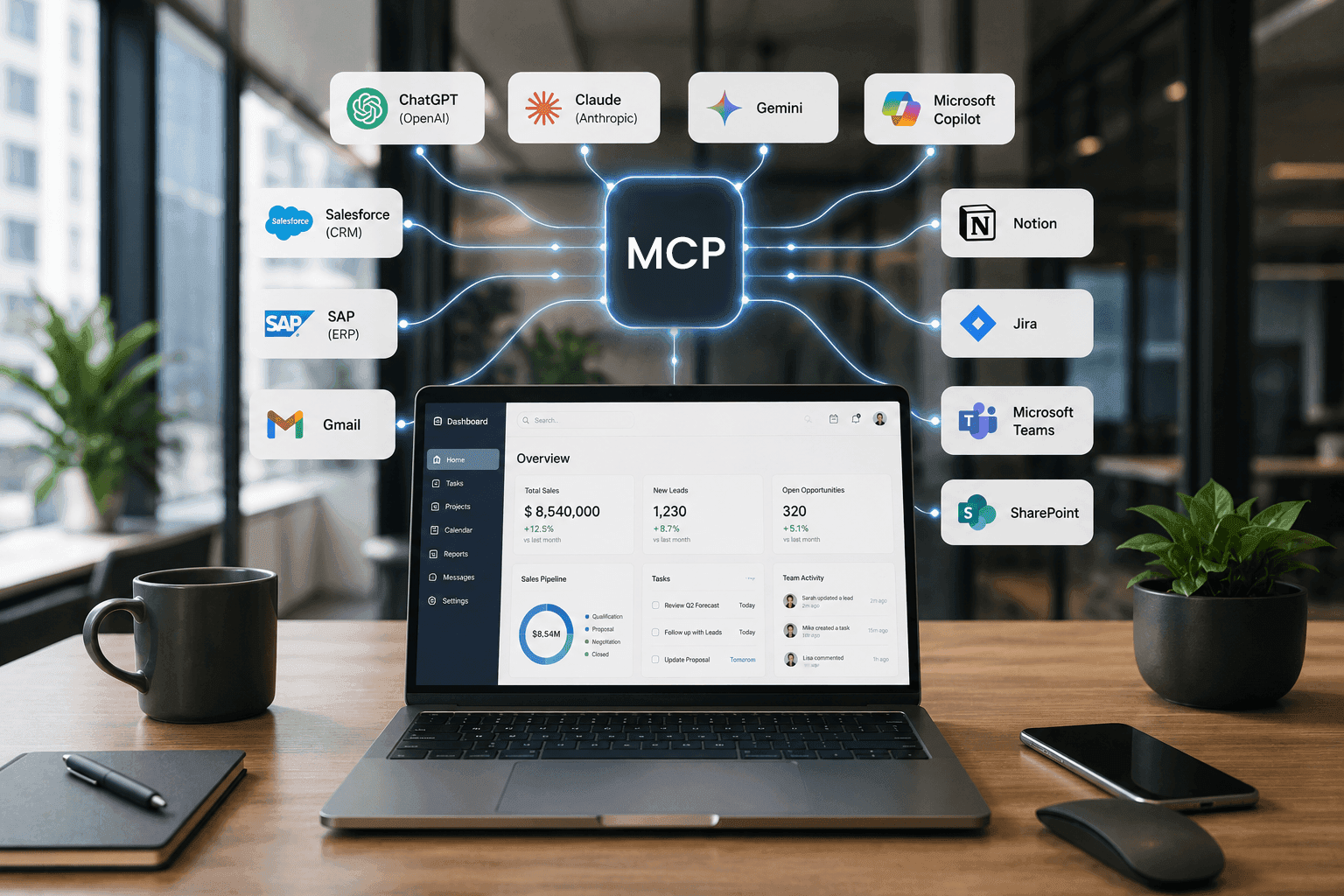
Think of MCP as a universal connector between AI and business tools, similar to how a USB port lets different devices plug into a laptop without needing a separate adapter for each one.
Instead of building a unique integration for every application, MCP provides a standardized way for AI systems to access information and perform actions across tools. This means an AI assistant can pull data from your CRM, update a task in your project management tool, or retrieve a document from your knowledge base, all through the same underlying protocol.
Developed with contributions from Anthropic, MCP is quickly becoming a reference point for how modern AI Model Context Protocol integrations are built. The goal is simple: reduce complexity so AI can work with your existing tech stack instead of around it.
How Model Context Protocol Works
At a high level, the flow looks like this:
Business Tools → MCP → AI Model → Intelligent Actions
Here's what happens in practice:
• The AI model requests access to relevant information through MCP.
• MCP provides secure access to the right business system, without exposing unnecessary data.
• The model receives shared context in real time, rather than relying on outdated or incomplete information.
• With accurate, up-to-date context, the AI can make better decisions and take meaningful action.
This structure supports smoother AI agent communication and enables genuine AI workflow automation, since the model isn't just generating text, it's acting on live, context-aware data.
Why Model Context Protocol Matters for Business Leaders
This is where MCP moves from a technical concept to a business advantage.
Faster AI Integration Across Business Systems
Instead of months-long custom integration projects, teams can connect AI to multiple tools using a reusable, standardized approach. This shortens deployment timelines significantly.
More Reliable AI Automation
Because MCP gives AI models accurate, real-time context, automated workflows are less prone to errors caused by outdated or incomplete data.
Easier Scalability for Future AI Initiatives
As your business adopts more AI agents and use cases, MCP-based integrations scale far more efficiently than one-off custom builds, supporting long-term enterprise automation. This is also why the underlying platform matters: a website built on outdated architecture will struggle to support this kind of scale, which is where modern website design and development becomes part of the AI readiness conversation.
Better Governance and Secure AI Tool Integration
MCP is designed with structured access controls in mind, giving IT and leadership teams more visibility and control over what data AI systems can access, an important factor for compliance and trust.
Together, these benefits make MCP a meaningful step toward stronger AI infrastructure and long-term digital transformation.
MCP vs Traditional API Integration: What's the Difference?
Traditional APIs are still valuable, but they were built for a different era of software, one where applications talk to applications, not AI agents making dynamic decisions.
Key differences worth understanding:
• Traditional APIs rely on point-to-point integrations; MCP uses standardized AI communication.
• APIs are built primarily for applications; MCP is built specifically for AI agents.
• API integrations often require custom development for each connection; MCP offers reusable integrations across tools.
• APIs typically provide limited context per request; MCP is designed for context-aware interactions.
In short, MCP isn't a replacement for APIs, it's a layer built to help AI use them more intelligently.
Business Applications of Model Context Protocol
MCP's potential spans nearly every department:
Customer Support: AI agents can pull order history, past tickets, and account details instantly, enabling faster, more personalized responses.
Sales & CRM: Sales teams can get AI-generated insights pulled directly from live CRM data, without manual lookups.
Marketing Automation: Campaign performance, audience segments, and content data can be accessed in context, supporting smarter, faster decisions, whether that data is feeding SEO efforts, social media marketing, or broader content marketing planning.
Internal Knowledge Management: Employees can query internal documentation and get accurate answers pulled directly from company systems.
Operations & Workflow Automation: Routine, multi-step processes across tools can be automated with AI acting on real, current data rather than static instructions.
These use cases show why connecting AI models to business tools through a standardized protocol is becoming a priority for forward-thinking organizations.
Frequently Asked Questions
What is Model Context Protocol (MCP) in AI?
Model Context Protocol is a standardized framework that allows AI models to securely connect with business tools, data sources, and systems, without requiring a custom integration for every application.
How does Model Context Protocol work?
MCP works by allowing AI models to request and receive context from connected business systems in real time. This shared context helps the AI take accurate, relevant actions rather than relying on static or outdated information.
Why should businesses use Model Context Protocol?
MCP simplifies AI integration, reduces development time, improves automation accuracy, and supports secure, scalable connections between AI agents and enterprise systems.
What is the difference between MCP and traditional APIs?
Traditional APIs connect applications to applications and typically require custom development for each integration. MCP is designed specifically for AI agents, offering standardized, reusable, and context-aware connections across multiple tools.
Can MCP improve AI workflow automation?
Yes. Because MCP provides real-time, accurate context to AI models, automated workflows become more reliable and require less manual correction.
What are the business applications of Model Context Protocol?
Common applications include customer support, sales and CRM automation, marketing analytics, internal knowledge management, and operations workflow automation.
Is Model Context Protocol the future of enterprise AI integration?
MCP is quickly emerging as a leading standard for connecting AI systems to business tools. While the technology is still evolving, its focus on standardization and security makes it a strong foundation for future enterprise AI integration.
Conclusion: Preparing Your Business for the Next Generation of AI
Model Context Protocol isn't just another AI term, it's an emerging standard that could reshape how businesses integrate AI into everyday operations. As organizations move toward intelligent automation and AI-driven workflows, understanding MCP today can help leaders make smarter technology decisions tomorrow.
Businesses that invest in scalable AI foundations will be better positioned to innovate, adapt, and compete in the years ahead. But adopting MCP or any AI integration successfully starts with having the right digital foundation already in place: a solid website, a clear content strategy, and systems built to scale.
If your organization is planning AI adoption, modern web platforms, or enterprise digital transformation, building the right technical foundation matters just as much as choosing the right AI tools. WebMaffia helps businesses create scalable digital experiences that are ready for the future of AI, from digital strategy and website design and development to SEO, social media marketing, content marketing, and influencer marketing.
Ready to future-proof your business? Get in touch with WebMaffia to start building your AI-ready digital foundation today.
following blog articles.